
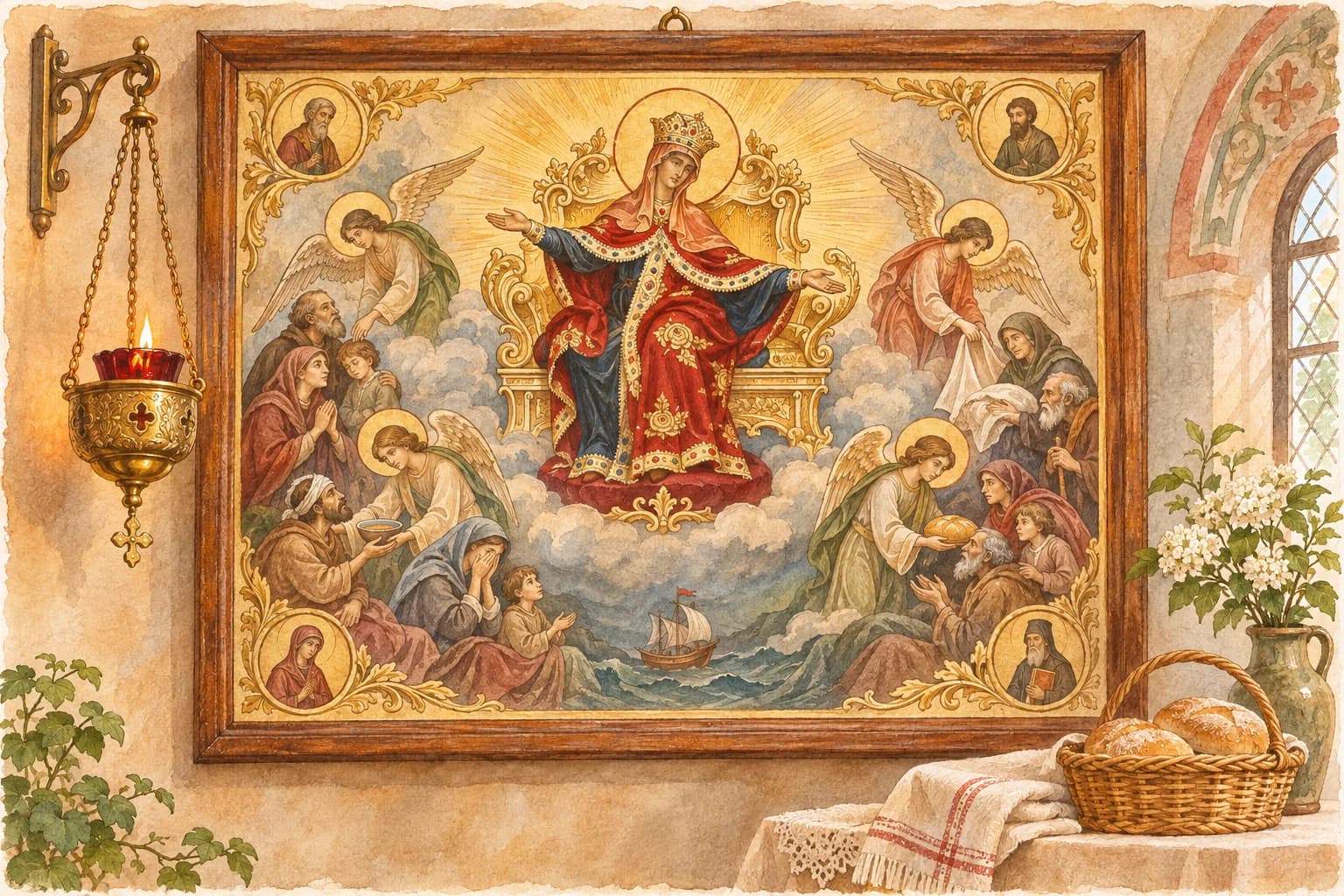
Joy of All Who Sorrow expresses hope in the Mother of God’s help for people in distress. Different versions depict those in need and angels around her. The title speaks of consolation rather than promising a life without further difficulties.
Different venerated copies have their own histories. Features of one should not automatically be attributed to every image with the same title. Location, inscription and the particular version matter when looking up its history.
Sorrow does not necessarily indicate deficient faith. Someone can pray while also needing medical, psychological or social support. It is wrong to shame a person because pain did not disappear immediately after prayer.
Begin with an honest prayer rather than a performance of calm. If another person is suffering, offer concrete help and ask what they need. Veneration can continue in attentive care for those actually grieving nearby.
Why suffering people surround the Mother of God
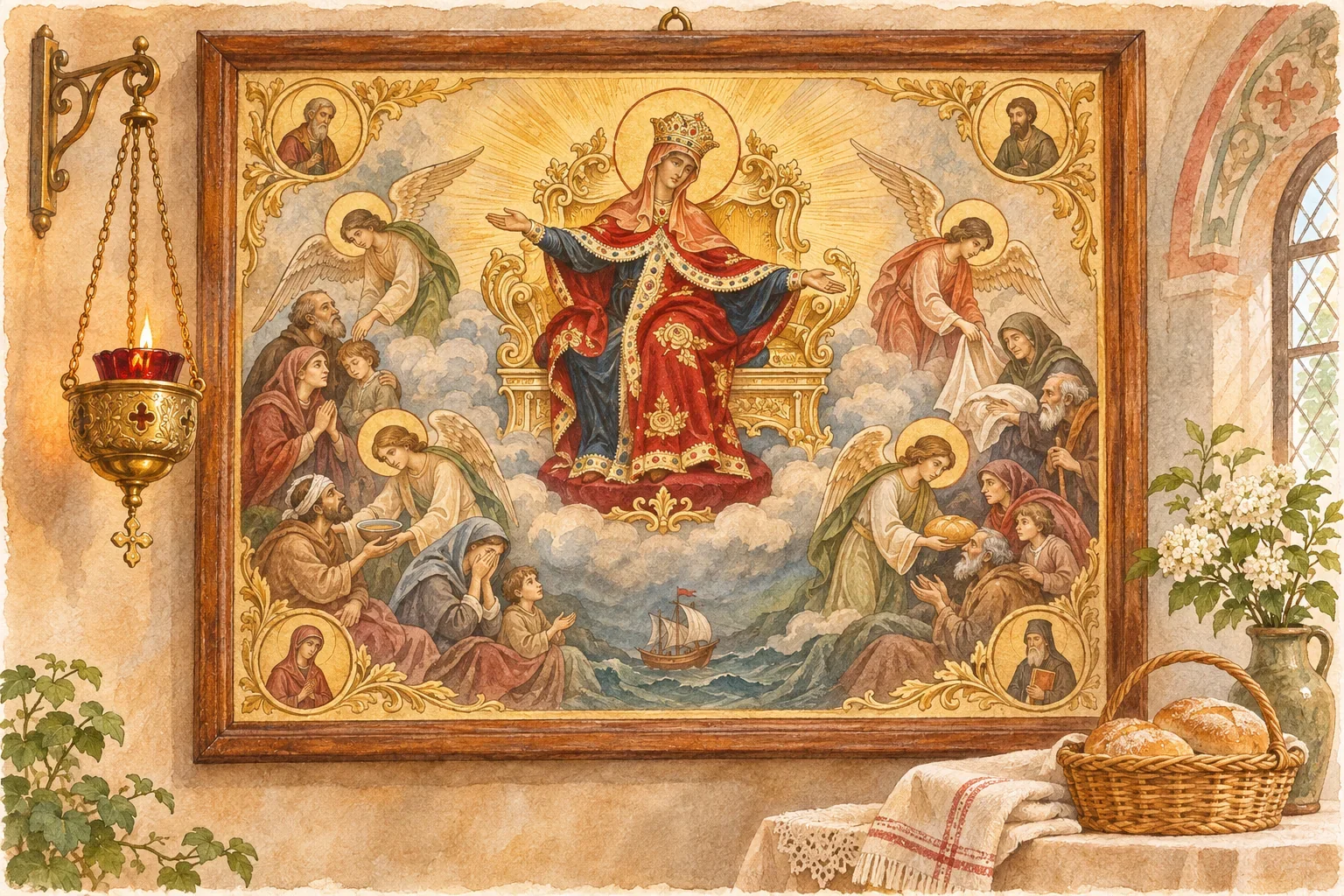
The composition of Joy of All Who Sorrow unfolds its title through several human needs. The Mother of God may be surrounded by sick, hungry, deprived or otherwise distressed people. Angels direct their attention towards her or participate in the depiction of consolation. The smaller figures are therefore not incidental decoration: they show that intercession concerns real human life.
Unlike a half-length image of Mother and Child, this type often presents an extended scene. Examine it in sequence: the central figure, gestures, groups and inscriptions. Captions may explain a particular need, but each person depicted should not automatically be identified as a historical individual. Many figures represent a human condition rather than a portrait of someone involved in one recorded event. This distinction allows the composition to address different viewers without losing its specific visual meaning.
Moscow veneration and the account of healing
A well-known history of the Moscow image concerns the church on Ordynka and the healing in 1688 of Euphemia, a sister of Patriarch Joachim. The church account describes her serious illness, prayer and a service before the icon. The image’s commemoration is associated with that event. A retelling should preserve the nature of the source: it is a testimony within church tradition about a particular healing.
The narrative does not amount to a medical promise of the same outcome for every sick person. Veneration has a meaning broader than one miraculous case: a person in distress is not forgotten, and the Church’s prayer can accompany suffering. For someone encountering the image for the first time, explaining that connection is more useful than reproducing the old account’s frightening description of illness in detail.
Why different versions exist
In some versions the Mother of God holds the Child; in others she is represented without him. The arrangement of people, inscriptions and angelic figures also varies. This does not mean the title belongs to only one permissible composition. Church history contains several revered images under this designation, each with its own material history and local tradition.
The Saint Petersburg version known as with the coins is especially familiar and has a distinct account concerning the image and coins. Its history should not be silently attached to the Moscow healing as though both concerned one object. If coins or unusual details appear in a photograph, establish the copy’s complete designation first. Separate notes recording city, church, composition and history make comparison easier and prevent different traditions from being merged.
Joy that does not require concealing pain
The title brings together two words that can initially appear opposed: sorrow and joy. It does not demand that someone immediately feel cheerful. A person may remain ill, bereaved or anxious and still receive support, an ability to pray and assurance that they are not abandoned. Consolation therefore does not always coincide with the rapid removal of suffering’s external cause.
It is appropriate to name a need honestly before the image. There is no requirement to display grateful composure simply to satisfy another person’s expectations. When someone persistently cannot sleep, manage daily life or cope with severe despair, professional assistance may be needed alongside pastoral support. These forms of care need not compete; they attend to different dimensions of human suffering and can work together without treating distress as evidence of failed faith.
How veneration relates to works of mercy
The needy figures on the icon invite attention to people nearby. After prayer, ask an ill acquaintance what would actually help, bring food to an isolated person or support someone who has suffered a loss. Offer a feasible action rather than a general promise to solve everything. Respect for dignity includes allowing the recipient to decline assistance or request a different form of it.
Within a parish, the image can introduce a discussion of charitable work. Establish actual needs and existing support services instead of collecting goods without an identified recipient. Prayer for people in sorrow acquires a visible continuation when someone learns to listen and act considerately. Charity does not become payment for an anticipated miracle; it is a response to a neighbour’s need. The icon’s many figures remind the viewer that those needs are varied rather than interchangeable.
A question for reflection
What support can you offer without promising to fix everything quickly?