
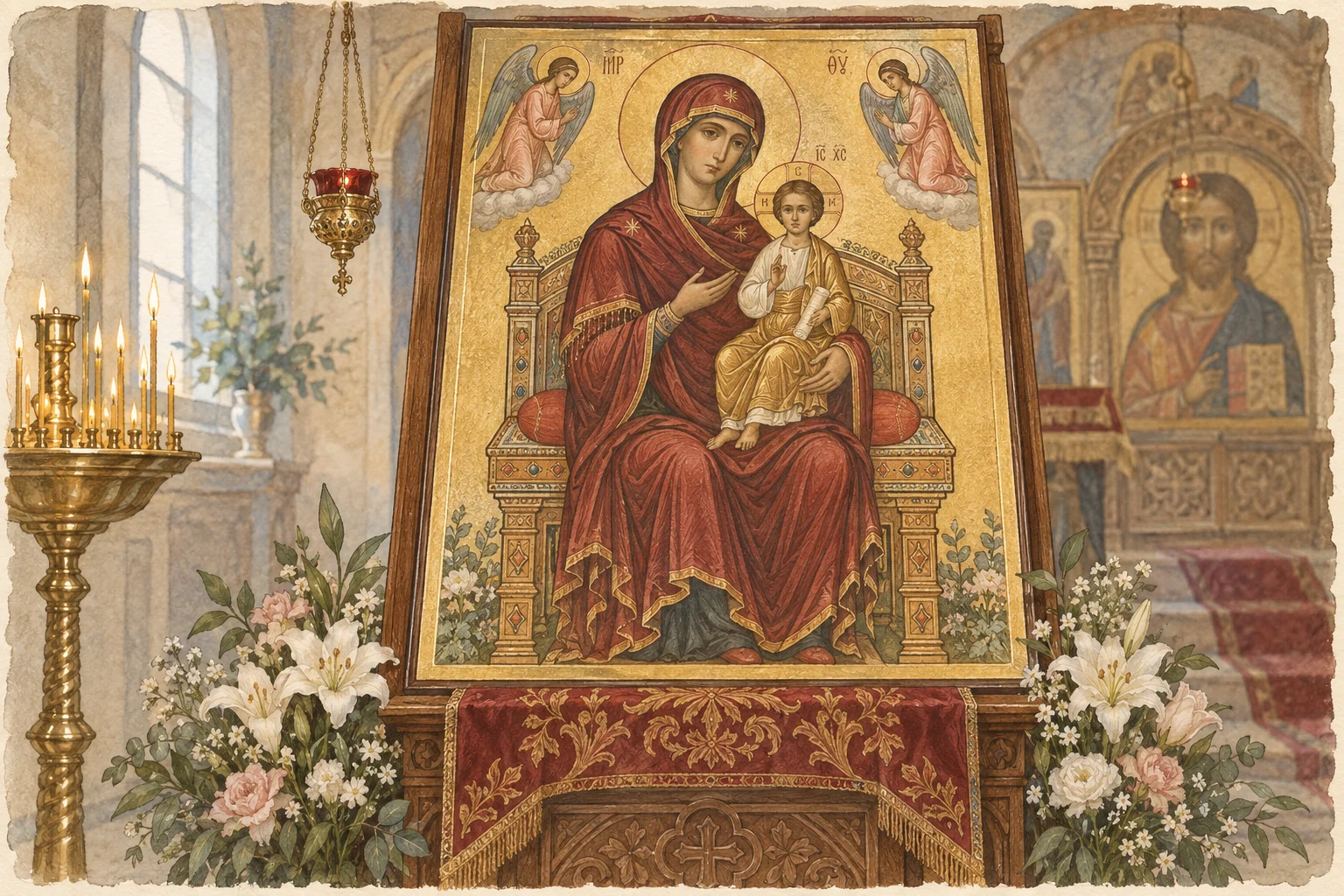
Pantanassa, commonly translated as Queen of All, is particularly familiar among people praying during serious illness. Its veneration does not authorise promises of recovery or judgements about someone's faith based on treatment outcomes. Prayer sustains relationships with God and other people; it does not replace assessment, prescribed treatment, or attention to a patient's quality of life.
The Athonite Image
Vatopedi Monastery on Mount Athos describes its image as a portable seventeenth-century icon. The widely venerated copies are associated with this prototype. The monastery publishes testimonies from people who understand help they received as miraculous. These belong to ecclesiastical remembrance, but do not by themselves establish the medical effectiveness of a particular prayer practice.
Distinguish the origin of the icon, the history of an individual copy, and a personal account of help. A photograph of a modern copy does not become a photograph of the ancient panel because an Athonite story accompanies it. For a particular icon's creation and transfer, consult information from the monastery or parish responsible for it.
Understanding the Name
The title honours Mary as Queen in relation to the glory of her Son. She is depicted with Christ, and her royal dignity should not be separated from him. She is neither a specialised goddess of healing nor an independent power governing illness. Orthodox prayer asks the Mother of God to intercede with the Lord.
Prayer before this image is therefore not limited to cancer. A person may bring fear of an examination, a family's exhaustion, the need for patience, or hope of assistance. No particular diagnosis is required before asking for intercession. Nor is there any requirement to conceal confusion behind elaborate religious language.
Prayer Alongside Treatment
Symptoms and diagnosed illness require medical decisions with qualified treating professionals. Do not delay seeking care in order to travel to an icon. Discuss supplements, herbs, and dietary restrictions with the clinician: a natural or monastic origin is not evidence that a product is safe during treatment.
When energy is limited, prayer may be brief. A relative can ask whether a visit from a priest is welcome and help arrange it without imposing participation. A demanding prayer rule must not be presented as a condition of recovery. Continuing illness does not prove that someone prayed badly, donated too little, or became unworthy of God's love.
Practical Support
Offer specific assistance: transport to an appointment, shopping, childcare, or an unhurried conversation. Ask permission first. Unsolicited streams of miracle stories may intensify guilt and the pressure to recover. Do not publish another person's diagnosis or photograph in a prayer group without their consent.
Russian observance commemorates the icon on civil August 31, corresponding to Julian August 18; Athonite and Greek practice includes other local dates. Their variation does not mean that prayer can be heard only on a special day. Someone unable to attend church can pray at home or in hospital. God's nearness is not measured by distance from a monastery. A considerate presence remains valuable whether the person recovers or continues to experience serious illness, and it need not be justified by a promise of a particular outcome.
Before giving an icon to someone ill, ask whether it would be welcome and convenient. A small bedside image may be comforting, but the gift should not require daily reports about prayers or emotional progress.
Why Thanksgiving Is Not a Treatment Plan
A testimony normally describes what someone experienced: fear, prayer, treatment, and a subsequent change. Even a sincere account does not contain all the information needed to choose care for another patient. Respecting the author's gratitude does not require reproducing their journey literally. In particular, do not compare people by suggesting that another person's recovery proves that the present patient is doing something wrong.
The title Queen of All also does not turn an item brought from a monastery into a tested medicine. If an icon is offered alongside an herbal mixture or supplement, that is a separate product to discuss separately with the treating clinician. The US National Cancer Institute warns that complementary products can interact with medicines. That discussion requires knowing the ingredients, not merely hearing where the product was purchased.
What to Say When Words Are Difficult
A visit need not begin with a prognosis or prayer rule. Ask whether the person wants to discuss illness today or would prefer ordinary conversation. Some want to retain an interest in work, books, and family events; others need a break from talking altogether. Do not demand constant cheerfulness. Receiving support should not require a patient to comfort visitors by displaying the right mood.
If someone welcomes shared prayer before Pantanassa, agree on a comfortable length and freedom to stop. Afterwards, do not test whether relief has appeared as though examining the icon's effectiveness. Ask instead what is needed now: quiet, water, or assistance with an ordinary task. This kind of presence leaves room for hope and uncertainty together. It promises no outcome that relatives cannot guarantee, while making clear that care will not disappear because the expected good news has not arrived. A person remains more than the changing account of their illness.
Sources
- Vatopedi Monastery: the Pantanassa icon
- Vatopedi Monastery: testimonies and commemorations
- US National Cancer Institute: treatment and complementary practices