
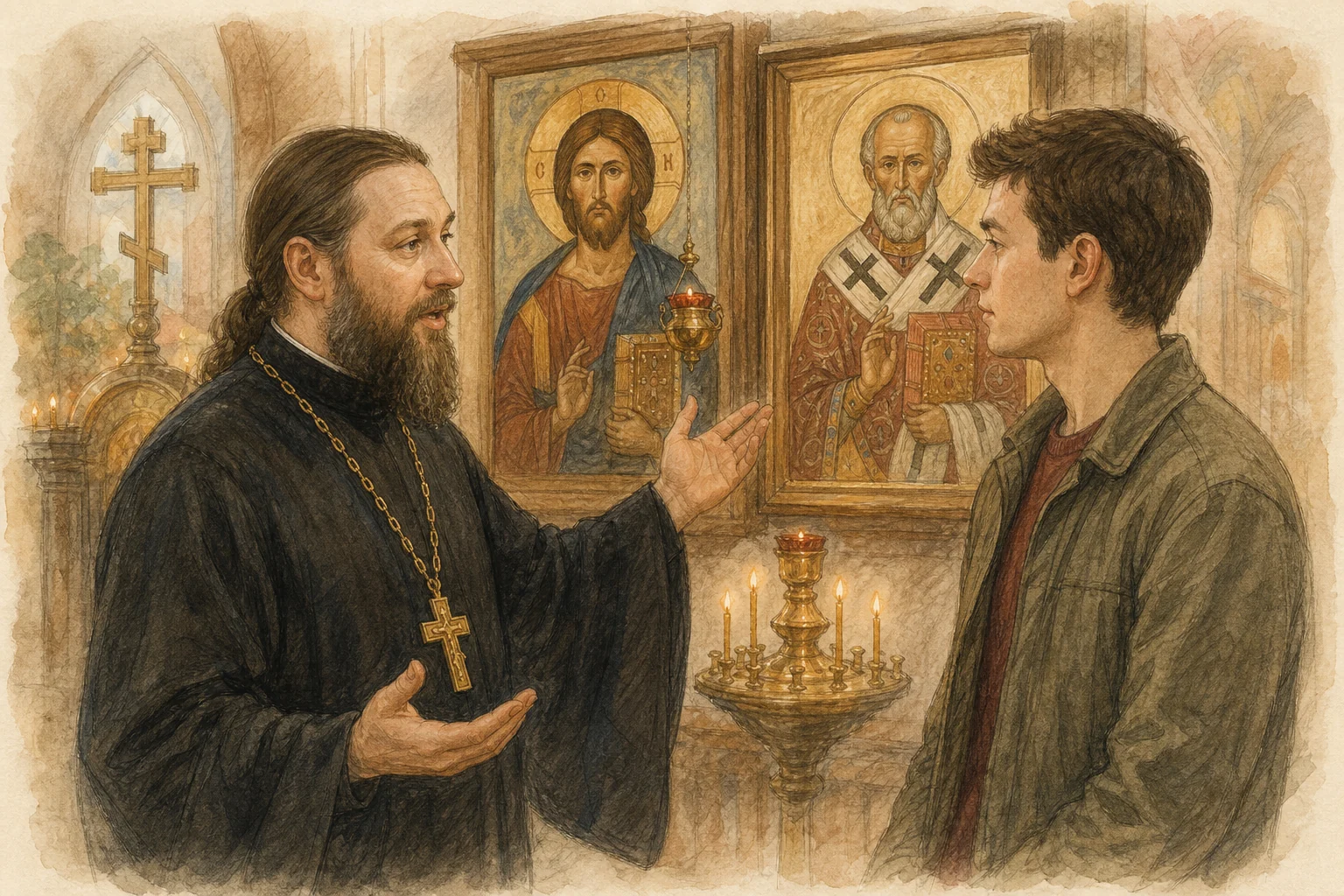
Orthodox Christians pray directly to God and also ask the saints to pray with them. The words “holy servant of God, pray for us” do not place a saint in God’s position. They request intercession, much as one asks a living Christian, “please pray for me.”
God alone saves, forgives sins, and gives grace. Saints possess no independent magical power and do not control God’s will.
What “praying to a saint” means
In modern English, “pray to” can sound identical to divine worship. Historically, to pray can also mean to ask. The actual Orthodox content is clearer: a Christian asks a saint for prayerful intercession before God.
The center remains explicit in the Church’s words: “pray to God for us.” A saint is not the final source of hope but a member of the one Church living with Christ.
May we speak to God without approaching a saint first?
Yes. The Lord’s Prayer, repentance, thanksgiving, and petitions are addressed directly to God. No one needs a saint’s permission before Christ will hear.
Intercession does not block direct prayer. It opens an isolated monologue into the communion of the Church. We pray personally while asking others to pray as well.
Why Christians ask one another for prayer
The apostolic writings repeatedly call believers to pray for one another. When a parishioner asks the community to remember someone who is ill, that request does not question God’s knowledge. It allows love to carry another person’s need together.
If the shared prayer of Christians on earth does not compete with Christ, the prayer of those who completed their earthly life in faith belongs to the same communion.
Are the saints not dead?
Physical death is real, but in Christ it does not finally sever communion. God is called the God of the living, and the Church confesses the resurrection of the dead and the life of the age to come.
Saints live in God not through an independent natural immortality and not because they became gods. Their life is Christ’s gift and a foretaste of the common resurrection.
How do we know that the Church in heaven prays?
Holy Scripture depicts heavenly worship and the prayers of the saints offered before God. The biblical “cloud of witnesses” also shows that the Christian race is not isolated from those who have completed it in faith.
Church practice did not grow from one detached sentence but within Scripture, worship, Tradition, and the life of the early Church. The Orthodox answer therefore reads biblical passages within the Church’s whole life.
But Christ is the one Mediator
Yes. Christ is the one Mediator between God and humanity in a unique and unrepeatable sense: He is true God and true man, incarnate, crucified, and risen for the salvation of the world. No saint, priest, or Christian friend can replace His work.
Intercessory prayer exists within Christ’s mediation, not beside it. Asking another person to pray does not create a second Savior; it is participation in the love of Christ’s Body.
Veneration and worship are different
Divine worship belongs only to the Father, Son, and Holy Spirit. Saints are honored as human beings in whom God’s grace has become visible. Christians thank God for their example and ask for their prayer.
When someone attributes independent control over fate to a saint or fears “offending” one by missing a ritual, veneration has been distorted into superstition. A saint leads toward Christ and does not collect worship for himself or herself.
Why the Mother of God receives special honor
The Virgin Mary is called Theotokos, “God-bearer” or “Mother of God,” because the One born from her, Jesus Christ, is true God become man. She is honored above all saints for her free assent to God and her unique place in the Incarnation.
She is neither a goddess nor a fourth Person of the Trinity. Every Orthodox appeal to the Theotokos understands her help as maternal intercession before her Son.
How can saints hear many requests?
The Church does not teach that each saint possesses independent omniscience. Communion between the saints and the earthly Church is possible by God’s grace and in God, who knows every heart.
There is no need to design a technical message-routing scheme. Prayer is a mystery of communion in Christ, not a heavenly call center.
Why people approach different saints
Believers may feel close to a saint because of a shared name, life circumstances, vocation, or personal history. A physician may remember a holy healer; a family may honor faithful married saints; a traveler may know a saint associated with journeys.
This does not mean every saint runs a narrow department. Every saint prays to God, and help comes from God. Lists assigning each saint exclusively to one problem must be treated soberly.
How to choose a saint to learn about
Read the life of the saint whose name you bear or of a saint represented in your parish. Read a short troparion or simply say, “Holy servant of God, pray to God for me.”
Do not immediately buy many objects or search for a guaranteed formula. It is better to know one life and see how that person’s faithfulness points to Christ.
Icons and prayer to a saint
An icon helps the person praying address a real person rather than an invented fantasy. Honor shown to the image passes to the prototype; wood and paint do not become an independent source of power.
Before an icon, Christians make the sign of the Cross, bow, pray, and may venerate it reverently. Our guides to icons at home and venerating an icon explain the practice further.
Who performs a miracle?
Church language may say “the saint helped,” meaning help granted by God through the saint’s prayers. God is the source of healing, protection, and salvation. A miracle is not a service purchased with a candle or promise.
Prayer for health does not replace a physician, and prayer for employment does not replace honest effort. If the desired outcome does not occur, it does not prove that the “wrong saint” was selected or too few repetitions were made.
Relics and pilgrimage
The Church honors the bodies of saints because the human body participates in sanctification and awaits resurrection. Veneration of relics is not belief that physical remains work as charms.
A pilgrimage should lead to prayer, repentance, worship, and love for neighbors. Crowding, collecting objects, or treating contact as an automatic guarantee contradicts the purpose.
How to avoid superstition
Do not distribute saints as talismans, carry an icon as a guarantee of success, or promise a ritual in exchange for a result. Never ask a saint to destroy a family, override another person’s freedom, or take revenge.
Check prayers copied online. A charm, occult appeal, or promise of automatic effect does not become Orthodox merely because a saint’s name has been attached.
A practical way to pray
Begin by addressing God, read a brief ecclesial prayer to the saint, name the need, and ask: “pray to God for me and help me act according to the Gospel.” Finish with thanksgiving and the Lord’s Prayer.
You may submit names of the living or departed and attend worship listed on the schedule page. A personal concern naturally enters the Church’s common prayer.
Frequently asked questions
Do saints grant wishes?
No. They pray to God, and prayer is not a mechanism for fulfilling wishes. A petition remains open to God’s will and moral responsibility.
May I pray only to Christ?
Direct prayer to Christ is necessary and always open. Asking saints for prayer is free participation in the Church’s communion, not a barrier.
Will a saint be offended if I forget a feast day?
No. Such fear turns honor into superstition. Return to prayer without panic and live according to the saint’s example.
May I ask a deceased person who has not been canonized to pray for me?
We pray to God for the departed. Public ecclesial invocation of someone as a saint is connected with canonization. Discuss difficult private cases with a priest.
How can I recognize an answer?
Do not seek secret signs in every coincidence. Assess circumstances soberly, seek counsel, and ask whether a decision leads toward truth, love, and responsibility.
The central point
Christians pray directly to God and ask the saints to pray with them. Christ remains the only Savior and Mediator; veneration of saints reveals the communion of His one Church.
If the practice is unfamiliar, begin with the Gospel and direct prayer to Christ, then ask an honest question through our contact page. Faith is not afraid of sincere inquiry.