
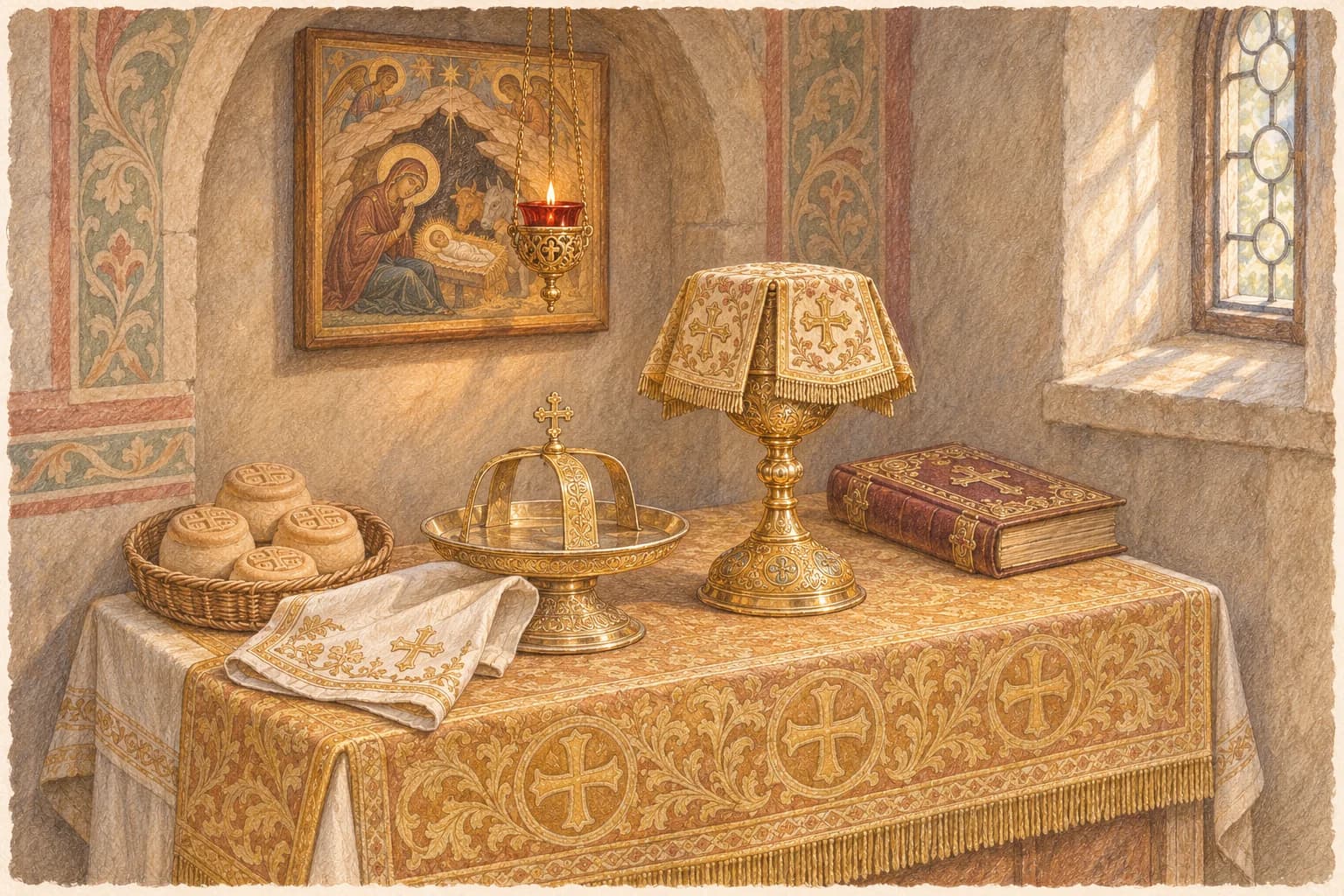
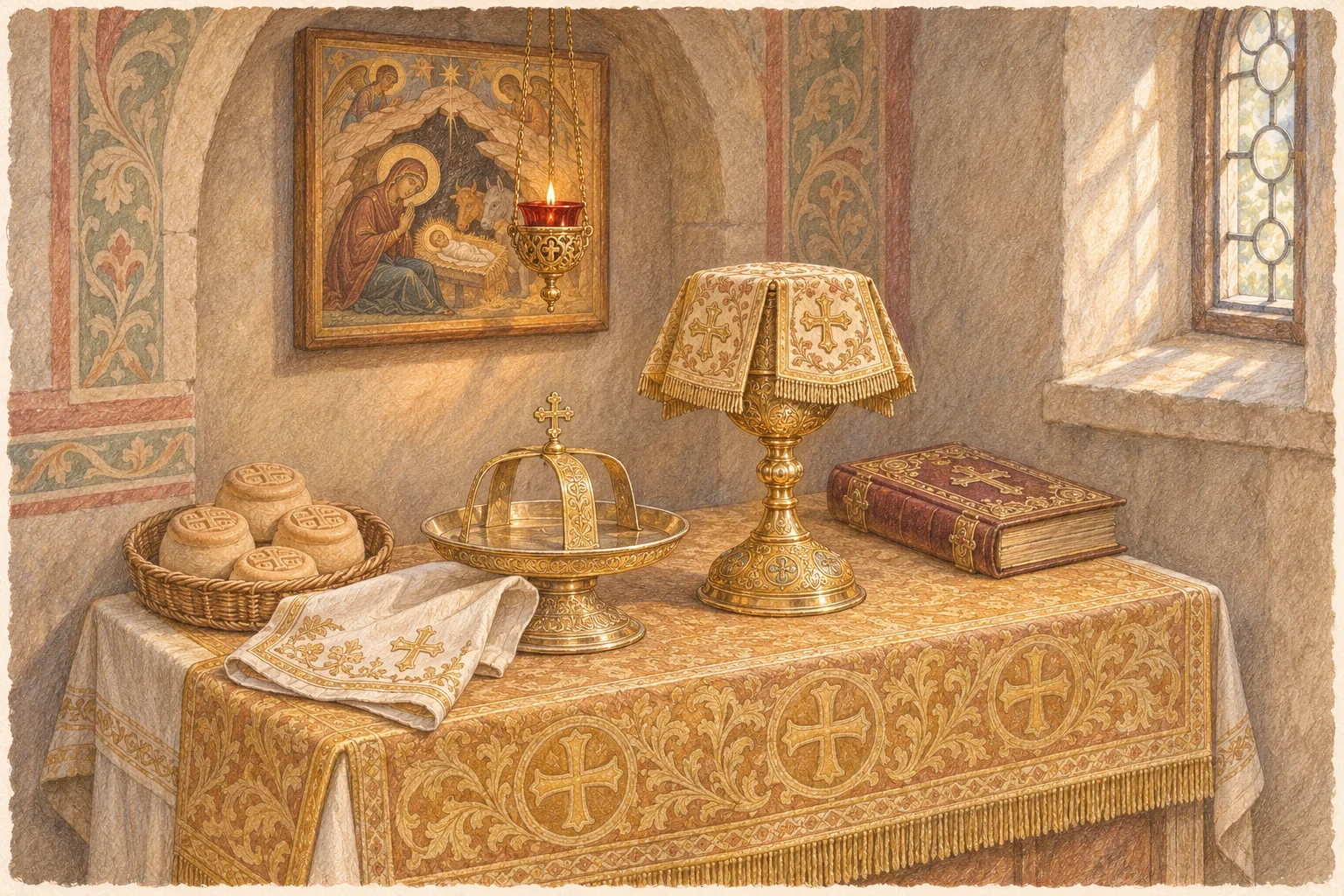
The table of preparation is the table in the sanctuary where bread and wine are prepared for the Liturgy. It is used for the proskomedia. The Holy Table has a different liturgical role: the distinction concerns the service, not merely the size or decoration of two tables.
In Russian practice the table is usually in the northern part of the sanctuary. Prosphora and sacred vessels are used there. The exact arrangement depends on the church: a textbook diagram explains the function without describing every building identically.
The name does not mean that animal sacrifices are performed in the church. Nor is the table a donation box. Similar religious vocabulary can refer to quite different actions, and confusing them obscures the meaning of Eucharistic worship.
When submitting names for commemoration, ask about parish arrangements beforehand. Do not try to deliver a note through the sanctuary or place something on the table yourself. A layperson participates through prayer and respect for the established order.
Where the prothesis stands and what it is for
The prothesis is the table in the sanctuary where the proskomedia, the preparation of bread and wine for the Liturgy, takes place. In a common Russian Orthodox arrangement, it stands on the northern side of the sanctuary. This helps orientation, but historic buildings and present-day worship spaces vary. Its defining feature is its liturgical purpose rather than a compulsory size or appearance.
The Russian name zhertvennik can confuse someone who pictures an ancient altar for animal sacrifice. In Christian worship the subject is preparation of the gifts in connection with the Eucharist. The word’s meaning cannot simply be transferred from an Old Testament ritual without explanation. The Church’s Liturgy refers to Christ’s unique sacrifice rather than treating the action as an ordinary handling of food.
What takes place during the proskomedia
The priest prepares bread and wine for the coming Liturgy according to the liturgical order. The Lamb used for Communion is prepared from a prosphoron, and commemorations are also made. In Russian practice, parishioners often associate this part of the service with submitting names of the living and departed. Yet the proskomedia is not merely the processing of a list: it belongs to the preparation of Eucharistic worship.
Someone submitting names does not see the entire rite and need not understand every movement to pray for loved ones. The central point is that remembrance enters the prayer of the Church rather than becoming an order for a guaranteed change of circumstances. Ask your own parish beforehand about submission times and how names are recorded, since practical arrangements can differ.
Distinguishing the prothesis from the holy table
The holy table is the principal sacred table associated with the celebration of the Eucharist. The prothesis is used in preparing the gifts. During the Liturgy, the gifts are carried to the holy table in the Great Entrance. Recognising that movement helps explain why the sanctuary has different places with different functions, even when both tables are covered with richly decorated cloths.
Size is not a reliable guide to terminology: a small holy table remains the holy table, and an elaborately decorated prothesis retains its own purpose. In an educational diagram, label the actions: where preparation occurs and where the Eucharist is celebrated. This explains the service rather than reducing learning to identifying furniture by details that vary between buildings.
Objects used in preparing the gifts
Liturgical vessels and implements are used at the proskomedia, including the diskos and chalice. The diskos holds the prepared bread, while the chalice contains the wine offered for the Eucharist. The liturgical spear has a specific role in preparing the prosphora. Learning these names alongside the explanation of the service is more useful than treating them as a collection of mysterious tools.
A photograph may show the objects before, during or after a particular action, so their arrangement is not always identical. A single image without context cannot reliably establish whether a service was conducted properly. For children’s material or a guided visit, use a checked church diagram and do not encourage people to reproduce sacred actions independently merely as a demonstration.
What matters for an ordinary church visitor
Because the prothesis is inside the sanctuary, visitors should not approach it independently simply to inspect it. Its purpose can be learned through a priest’s explanation, an appropriately arranged educational visit or a reliable guide. Not seeing every part of the preparation does not exclude parishioners from the Liturgy: shared prayer does not depend on examining every object at close range.
If your original question arose from wanting a loved one remembered, the practical next step is to ask how to submit the name and participate in prayer yourself. If your interest is church architecture, compare the prothesis, holy table and analogion by function. Many descriptions of the Liturgy then become clearer, and further details fit into a coherent understanding of worship.
Why preparation precedes the congregation’s attention to the readings
Many parishioners arrive after the preparation has taken place and may imagine it as a separate service obtainable independently of the Liturgy. In fact, the proskomedia belongs with the Eucharistic worship that follows. Find out the service time and arrive early enough to submit names and settle without haste. A late request does not entitle someone to demand that the whole rite be repeated. If you arrive too late, calmly ask how the names can subsequently be commemorated. Personal prayer for the loved one remains possible in the meantime.
A question for reflection
Are you distinguishing the place of preparation from the collection of donations?