
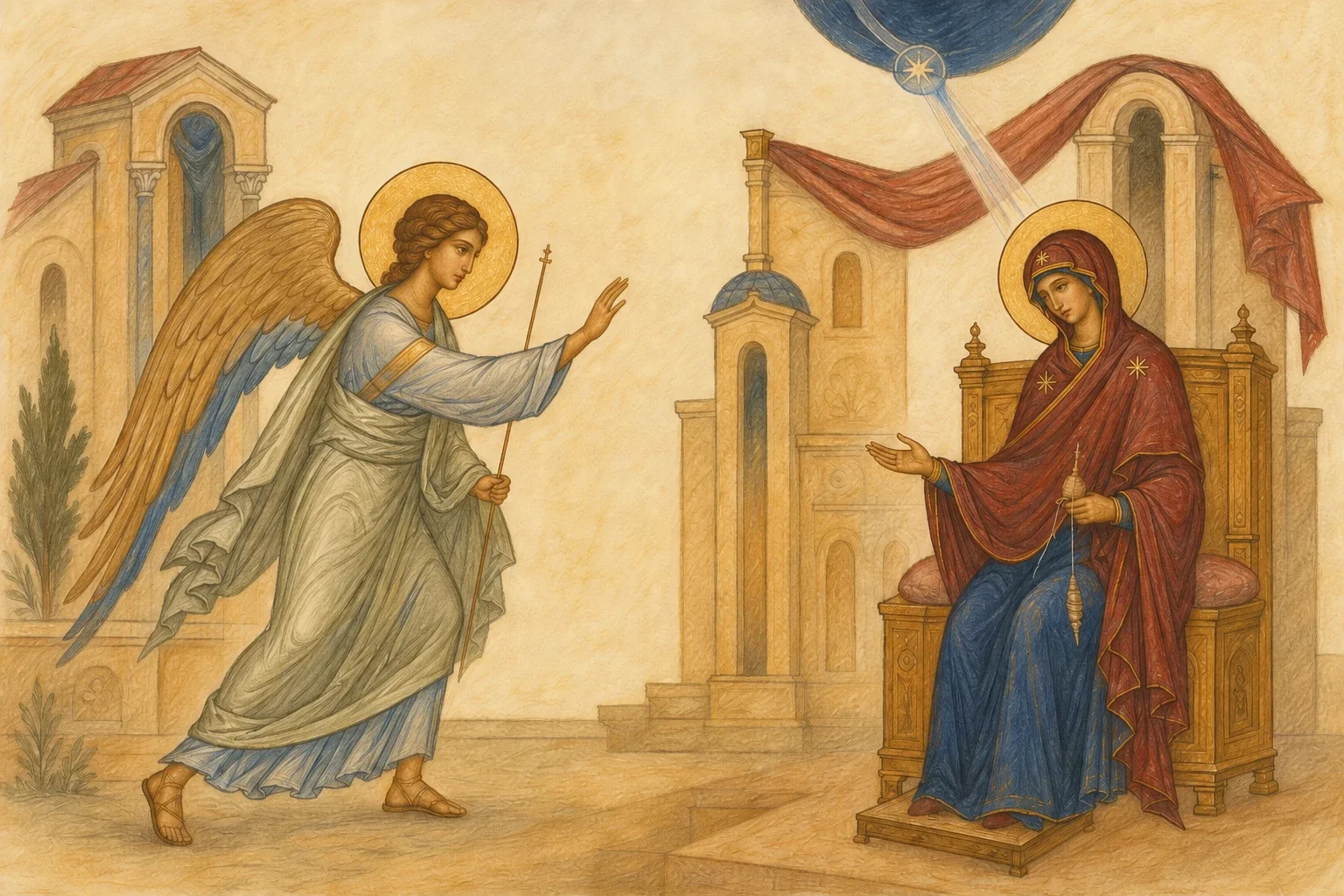
The Annunciation of the Mother of God is the Great Feast celebrated on April 7 in the Russian Orthodox calendar, remembering the Archangel Gabriel’s message to the Virgin Mary that the Savior would be born from her. The name means “good news,” and the account appears in the first chapter of Luke.
The Incarnation begins at this moment: the Son of God receives human nature. Mary answers freely and trustfully—not as a powerless instrument but as a person who hears a question, reflects, and consents to serve God’s purpose.
Why the message is good news
Humanity is not left alone with sin and death. God comes to save the world by entering human history and receiving flesh from the Virgin Mary.
The message does not promise Mary an easy life. Misunderstanding, flight, anxiety, and standing at the Cross await her. Gospel goodness is deeper than convenience: God remains with humanity and leads through suffering to Resurrection.
What Luke narrates
Gabriel comes to Mary in Nazareth and greets her as one who has received grace. She is troubled and considers the meaning of the words; the angel says she will bear a Son and name Him Jesus.
Mary asks how this can be, since she does not know a man. After hearing about the action of the Holy Spirit, she answers, “Behold the handmaid of the Lord; let it be to me according to your word.”
Is Mary’s answer free?
Yes. The Gospel shows a question, dialogue, and conscious consent. God does not destroy human freedom but awaits an answer. Mary’s humility is courageous trust, not fear before violence.
Her words must never be used to demand that another person endure evil silently. Christian obedience to God does not justify domestic abuse, exploitation, or suppression of personality.
Why the Incarnation begins here
At the Annunciation the Word becomes flesh in the Virgin’s womb. Nativity nine months later celebrates the Child’s appearance to the world, but Christ’s human life does not begin in Bethlehem.
The feast affirms the dignity of human embodiment and motherhood without reducing a woman’s value to the ability to bear a child.
What the name Jesus means
The name points to salvation: the Lord saves. The Archangel gives it before the birth and joins the identity of the Child to His mission.
Salvation is neither a political victory nor a guarantee of domestic success. Christ frees humanity from sin and death through His life, Cross, and Resurrection.
Why Mary is called Theotokos
She does not give birth to a separate human person later joined to God, but to Jesus Christ, the one Son of God, truly divine and truly human. The title therefore protects the Church’s faith concerning Christ.
Orthodox Christians worship God and venerate the Theotokos, asking her prayers. Our article on prayer to saints explains this distinction.
The Annunciation and the Nativity
April 7 and January 7 are separated by nine months within the corresponding calendar cycle. The feasts form one journey from the accepted message to Christ’s birth.
Our guide to the Nativity of Christ continues the story through the cave, manger, shepherds, and Magi.
Old Testament images
The service recalls the prophecy of the Virgin and Emmanuel, Jacob’s ladder, the burning bush, the Ark, and the Temple. These images speak about God’s presence without exhausting the mystery in one metaphor.
They must not be treated as proof by accidental verbal coincidence. The Church reads the Old Testament in the light of Christ within a complete Tradition.
Reading the Annunciation icon
Gabriel moves toward Mary and announces the message; she appears near a high seat or within stylized architecture. Her open hand expresses acceptance while the turn of her body may preserve attentive caution.
A ray from above indicates the action of the Holy Spirit. The gold background and buildings do not reconstruct a room in Nazareth but place the event within God’s purpose.
Why Mary holds thread or a spindle
Church Tradition associates Mary with work on the Temple veil. Red thread also becomes an image of the flesh that the Word receives from her.
This is a theological symbol, not a domestic instruction or a claim that female holiness is measured by needlework.
Why a white lily is not required
The lily became a widespread Western symbol of purity. The classical Orthodox icon emphasizes Gabriel’s staff, the thread, and the gestures instead. Absence of the flower changes nothing about faith in Mary’s virginity.
Do not judge an icon by one object alone. Its agreement with the Church’s meaning matters more.
When the feast is celebrated
The Russian Orthodox Church celebrates March 25 in the Julian calendar, corresponding to April 7 in the current civil calendar. The date is fixed.
Pascha moves, so the Annunciation can fall at different points in Great Lent and may coincide with Holy Week or Paschal services. The liturgical order then combines texts in a particular way.
The Annunciation during Great Lent
The feast brings joy into the penitential journey. The calendar normally provides a food relaxation, often permitting fish, but the exact rule depends on the weekday and any Holy Week coincidence.
Do not apply one line from an old calendar to every year. Check the actual date and personal measure, especially during illness.
How the service is arranged
The feast includes a vigil and Divine Liturgy, but its combination with Lenten worship may look different each year. Consult the parish schedule for the actual sequence and time.
Listen for the troparion’s proclamation that this is “the beginning of our salvation.” One intelligible key can open a long liturgical text.
Holy Communion on the Annunciation
The feast naturally leads to the Eucharist. Prepare through prayer, the Eucharistic fast, repentance, and the parish order for Confession.
A festal relaxation of the day’s food rule does not cancel the fast immediately before the Chalice. Discuss illness and medicine beforehand.
The custom of releasing birds
Releasing birds became a Russian cultural image of freedom and good news. It is not a required part of the Church’s worship.
Never buy trapped birds and release unprepared animals for a photograph; the practice can kill them and sustain cruelty. Caring for life gives better thanks to the Creator.
May Christians work and clean?
Necessary employment, care for a person, food preparation, and cleaning are not sins. Make room for worship when possible and reduce optional haste.
A proverb about a bird not building a nest does not create a magical prohibition against combing hair, sewing, or labor. Conscience must not be governed by a household omen.
The feast and pregnancy
The Annunciation may be especially close to a pregnant woman, but it does not promise freedom from medical difficulty or replace clinical care. Prayer and responsible medicine are compatible.
Do not require a woman to imitate Mary as though she had no right to fear, ask questions, or seek help. The Gospel itself records Mary’s question to Gabriel.
When motherhood is a painful theme
Someone experiencing infertility, pregnancy loss, the death of a child, or a failed adoption may find the language of the feast painful. The Church must not convert suffering into an accusation of insufficient faith.
A person may pray briefly, speak with someone trusted, and seek qualified support. Human worth before God is not determined by family status.
Explaining the feast to a child
Say that an angel brought Mary good news, she listened to God, and she freely agreed to become the Mother of Jesus. Read a few verses from Luke and examine the gestures in the icon.
Invite the child to carry good news: express thanks, make peace, or write to someone lonely. The word Annunciation then receives a practical meaning.
Saying yes to God today
There is no need to seek a dramatic revelation. The answer begins with a known commandment: speak truth, refuse revenge, fulfill a promise, defend the weak, pray, and make a responsible decision.
A true vocation never abolishes discernment, safety, and freedom. If a “spiritual direction” demands secrecy, humiliation, or unconditional submission to a human being, stop and seek independent help.
Common questions
What does Annunciation mean?
Good news: the Archangel tells Mary about the Incarnation and birth of the Savior.
Why is the feast always April 7?
It is March 25 in the Julian calendar used by the Russian Orthodox Church, nine months before Nativity in the same cycle.
Is fish permitted?
It often is, but a Holy Week coincidence changes the rule. Check the particular year.
Must birds be released?
No. It is a cultural custom and is acceptable only when it causes no harm to animals.
May a wedding be crowned on the feast?
Crowning is generally not celebrated on a Great Feast or during Great Lent. Agree on a date with the parish first.
The essential point
The Annunciation is the beginning of salvation’s fulfillment: God comes to humanity and Mary freely answers with trust. Her humility does not destroy personality; it is courageous readiness to serve love.
Meet the feast through the Gospel, Liturgy when possible, and a word of genuine good news for a neighbor. Reject omens and allow the Incarnation to change a real decision.