
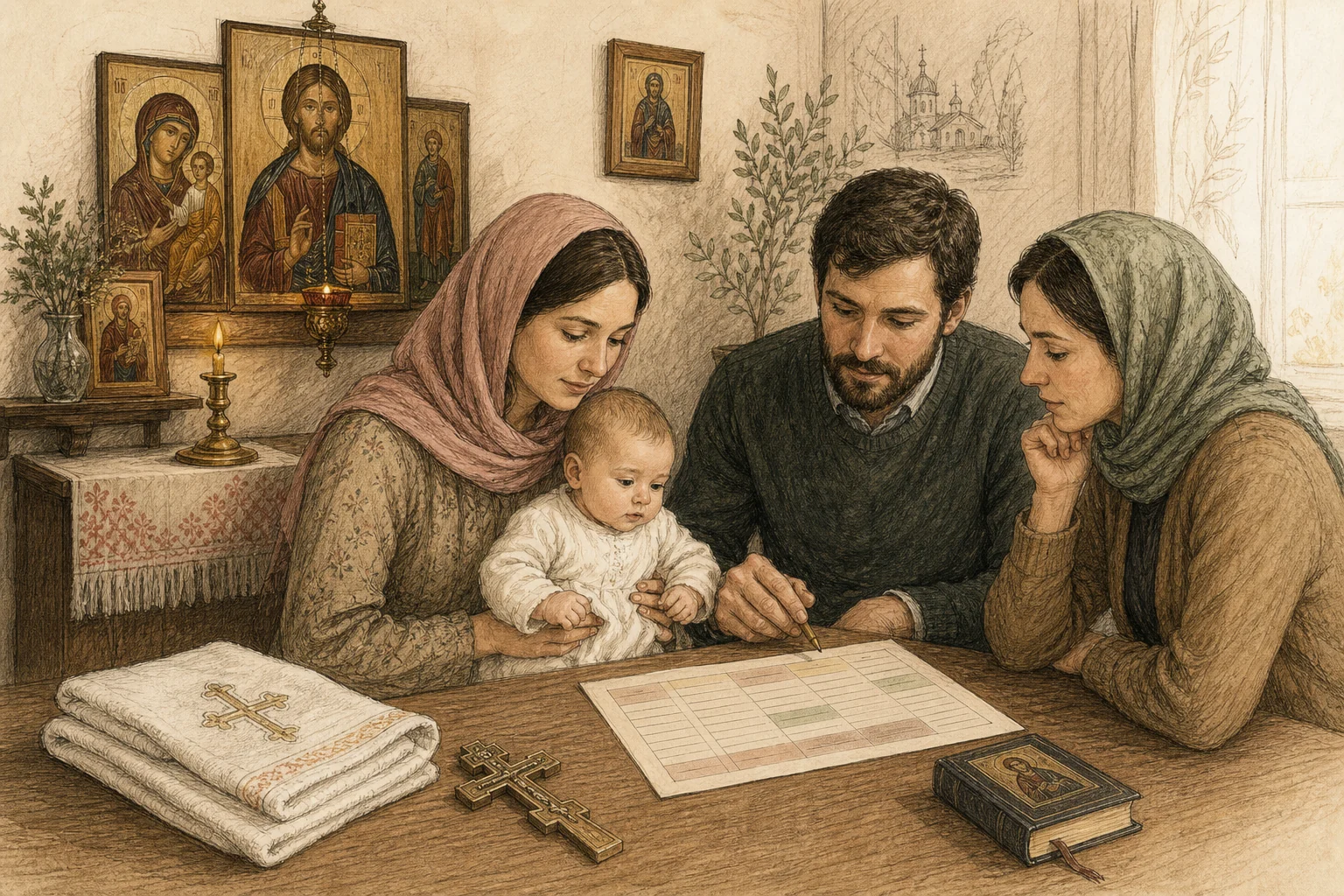
After a child’s Baptism, ask the priest when to come for the first Holy Communion, keep the baptismal certificate, begin brief family prayer, and agree with the godparents on practical involvement. The sacrament has been completed, but Christian life has only begun. There is no set of superstitious actions required with clothing, candles, or water.
During the first days, ordinary care, the child’s peace, and a calm entry into worship matter more than attempting dozens of new rules at once.
Clarify the first Communion
In the Orthodox Church, a baptized and chrismated infant may participate in the Eucharist. Ask the priest who celebrated the Baptism whether to come to the nearest Divine Liturgy or another agreed day.
Learn the starting time, which portion of the service is practical with the infant, and where the family should stand. The schedule page gives current services, while pastoral guidance considers the particular age and condition.
How to prepare an infant for Communion
Do not impose an adult Eucharistic fast on an infant or leave the child dangerously hungry. Feeding depends on age and health and should be discussed with the priest while preserving medical safety.
Bring a cloth, change of clothing, and ordinary care supplies. If the child becomes ill or unwell, call the parish and reschedule calmly or ask about Communion at home.
What to do with the baptismal cross
The cross is worn as a sign of belonging to Christ, not as an amulet. For an infant, choose a light cross and a safe soft cord of suitable length, checking that fasteners and edges do not injure the skin.
During sleep or any situation involving strangulation risk, follow child-safety guidance and a pediatrician’s advice. The cross may be kept nearby and worn safely; there is no need to fear removing it temporarily for a medical procedure.
The baptismal garment and towel
They may be dried, washed when needed, and kept as a family remembrance or used respectfully. The Church does not teach that the fabric must never be touched or washed, or that it automatically cures illness.
Do not wrap an ill child in the garment instead of seeking medical care. If the material is damaged beyond use, ask the parish about reverent disposal without turning it into a source of fear.
What to do with the candle
The candle may be offered at church in thanksgiving or lit at home during prayer with proper fire safety. There is no requirement to preserve it until a wedding, use it for every illness, or read the future from the wax.
Never leave a flame unattended or near the child. The spiritual meaning of a candle is prayer and offering, not prediction.
The baptismal certificate
Check the name, date, parish, and information about the sponsors. Keep the certificate with important family documents and make a digital copy in case it is lost.
It is not a civil identity document and does not replace life in the Church, but it helps a parish confirm that Baptism was celebrated.
The patron saint and name day
Clarify in whose honor the Church name was given and when that saint is commemorated. Read the life from a reliable Orthodox source, choose an understandable icon, and gradually tell the child about the patron.
A name day is not simply a second birthday for gifts. It is an occasion for prayer, Communion, and thanksgiving. The date must not become divination about personality or fate.
Brief prayer at home
Parents may make the sign of the Cross over the child, give thanks, and say the child’s name during morning or evening prayer. A few peaceful minutes are sufficient; a lengthy loud rule beside an exhausted infant is unnecessary.
As the child grows, he or she joins the words. Our guide to starting prayer at home helps a family begin without overload.
What godparents should now do
During the first week, sponsors can agree with the parents about the next Communion and regular contact. Thereafter, they pray by name, visit, assist with church attendance, and answer questions together with the parents.
Do not compete for influence or measure care through gifts. Our guide to the ministry of godparents offers a detailed plan.
Beginning church attendance with a child
The family need not remain through every minute of a long service on the first attempt. Arrive early or for a manageable portion, choose a place with an easy exit, bring one quiet toy, and keep passages clear.
Crying is not a bad sign. Step outside to settle the child and return when possible. The community also has a duty to receive families kindly.
Must the child receive Communion every week?
Regularity is valuable, but the family develops a rhythm with the priest while considering health, distance, and the parents’ ability to worship. Frequency should not become a competition.
A child’s Communion does not exempt adults from their own prayer, repentance, and Church life. The household grows together.
When confession will begin
Infants and young children receive Communion without confession. The movement toward a first confession depends on age, awareness of responsibility, and pastoral judgment rather than one automatic birthday for every child.
Read our guide to preparing a child for first confession, and never frighten the child with a priest or divine punishment.
Photographs and the child’s privacy
Select a few respectful photographs, never publish nudity, and obtain the consent of other people shown. The sacrament does not need to become a public report on social media.
Godparents and photographers do not gain automatic permission to post images. The child’s dignity and safety matter more than reach.
If the parents and sponsors quarrel
Do not use the child as leverage or declare the sacrament cancelled. Try a calm conversation; for a serious conflict, seek pastoral advice.
A godparent cannot be formally replaced retroactively, but other reliable Christians and the parish can support the child. The parents retain the central responsibility.
If the child becomes ill after Baptism
Seek medical care according to symptoms. Illness does not mean the sacrament was performed incorrectly, someone placed an evil eye on the child, or Baptism must be repeated.
You may ask for the priest’s prayer, submit the child’s name, and discuss Communion at home. Prayer accompanies treatment rather than replacing it.
How to keep the baptismal anniversary
Record the date. Each year the family can attend the Liturgy, give thanks, receive Communion when prepared, and look at photographs or read about the sacrament together.
A small family custom helps the child understand personal history. An expensive party is not required.
A plan for the first year
During the first month, establish Communion and brief prayer. Then become acquainted with the parish, choose an age-appropriate Gospel book, learn about the patron saint, and schedule regular contact with the godparents.
At the end of the year, assess not the number of icons purchased but whether the family prays, worships, and learns mercy. Small steady steps are more reliable than a ceremonial burst.
Frequently asked questions
May the child be bathed after Baptism?
Normal hygiene continues. Regarding the anointed areas and timing of the first bath, follow the priest’s particular instruction and any medical need.
Must the hair cut in the rite be kept?
Tonsure belongs to the rite, but a family need not turn hair into a charm. Ask how the parish handled it and whether anything was given to you.
May the cross be replaced?
Yes, replace a cross that is too small, sharp, or unsafe. Ask the parish whether the new cross should be blessed.
What should be given to the godparents?
A gift is not required. Gratitude, a photograph, and an honest agreement about future participation matter more than an expensive object.
Must the rite be repeated after a year?
No. Baptism and Chrismation are not repeated. Christian life continues through Communion, repentance, prayer, and love.
A concise conclusion
The first Communion, a safe cross, a preserved certificate, brief family prayer, contact with godparents, and gradual participation in the Liturgy are the main steps after Baptism.
Use the parish contact page for the practical order. Do not let superstition obscure what matters: the child has been received into the Church, and the family is now called to live this faith.