
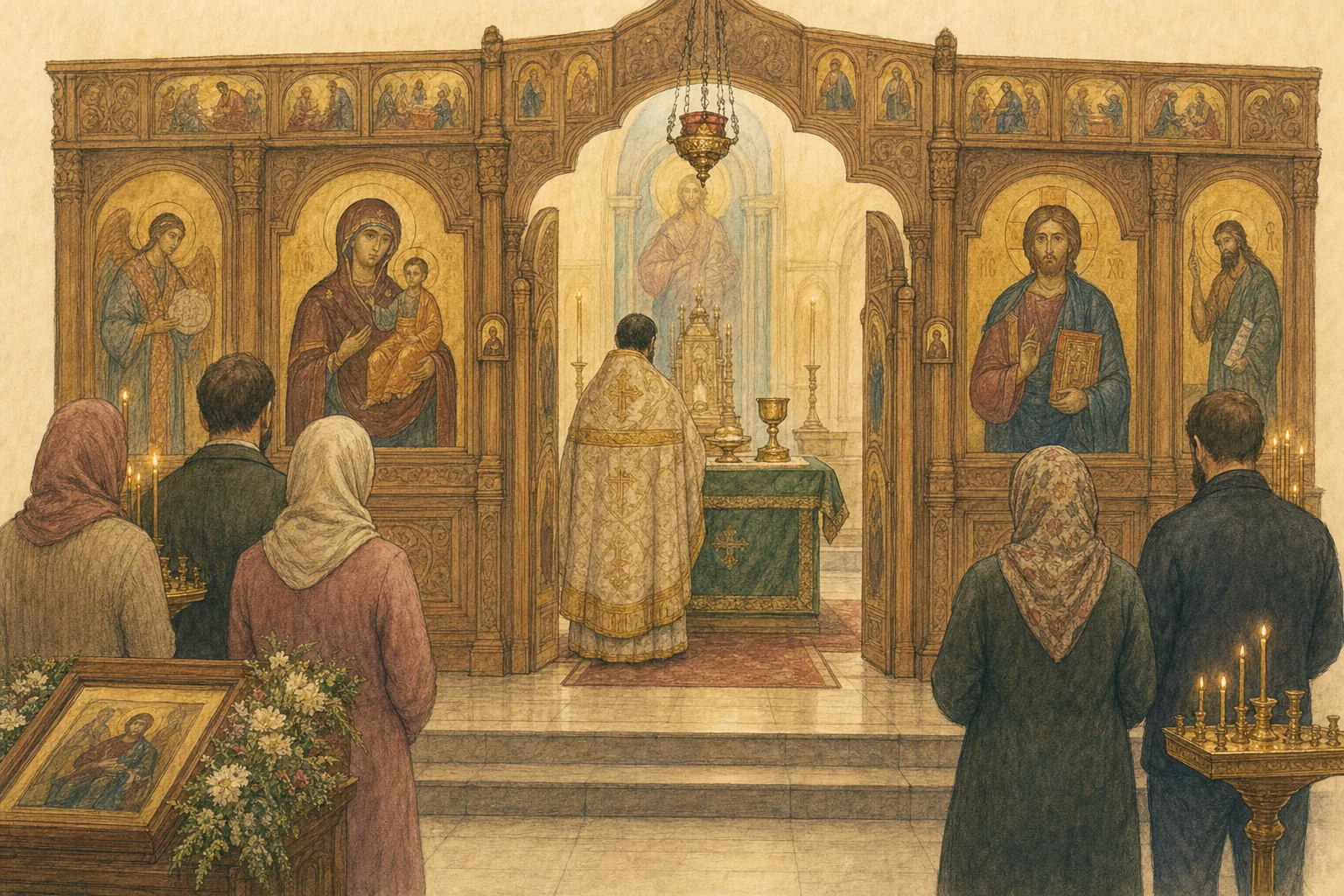
The Eucharist is the heart of the Divine Liturgy. In this Mystery the Church receives the true Body and Blood of Christ under the forms of bread and wine.
The Liturgy is not an outer ceremony surrounding one isolated sacred moment. It is one common act of worship: the Church gathers, hears the Word of God, gives thanks, offers the gifts, invokes the Holy Spirit, receives Communion and returns to the world in the peace of Christ.
The best answer to “What is the difference between the Eucharist and the Liturgy?” therefore begins with their unity. The Divine Liturgy is the whole ecclesial action; the Eucharist is its centre and fulfilment; Holy Communion is our personal and common participation in this Mystery.
Who this guide is for
It is for a first-time visitor who has heard the word “Eucharist”, for someone who attends the Liturgy but does not yet understand its movement, and for an Orthodox Christian wishing to prepare for Communion without superstition or anxiety.
This article is a map, not a replacement for catechesis or a conversation with a priest. It explains the central words, shows how the parts of the service belong together, and identifies the practical questions that should be confirmed in one's own parish.
Three related words
Divine Liturgy is the principal common worship of the Orthodox Church. The community gathers, hears the Epistle and Gospel, offers the eucharistic prayer and receives the Holy Mysteries.
Eucharist means thanksgiving. The word can name the Mystery and the whole eucharistic action of the Church: gathering, prayer, offering bread and wine, thanksgiving, consecration and Communion.
Holy Communion emphasises our participation in Christ and our unity in the Church. In ordinary speech, “Eucharist” and “Communion” are often used closely, but each word helps us see a different aspect of the same ecclesial reality.
What “Eucharist” means
Thanksgiving here is more than a polite feeling of gratitude. The Church gives thanks for creation, salvation, the Cross, Resurrection and Ascension of Christ, and the gift of the Kingdom to come.
We come not only to ask for help. We learn to receive life as a gift and to offer ourselves, our work, joy, pain and hope to God together with the community.
Thanksgiving does not remove repentance. Honest repentance frees us from pretending and teaches us to receive Christ as mercy, not as a reward we have earned.
The Mystical Supper and Christ's command
The Church finds the foundation of the Eucharist in the Mystical Supper. Christ took bread and the cup, gave thanks, gave them to His disciples as His Body and Blood, and commanded them to do this in remembrance of Him.
The Liturgy does not stage the Supper as theatre or repeat the sacrifice of the Cross as though it had been incomplete. The Church enters the living remembrance of Christ's saving work and receives its fruit.
Liturgical remembrance is not merely thinking about a distant event. It confesses that what Christ accomplished embraces the Church and each person now.
Why the Eucharist is central to Church life
In the Eucharist the Church does not merely speak about union with Christ; she lives it. Those gathered are not unrelated visitors in one building but a community called to become one Body in Christ.
Prayer, learning the faith, mercy, repentance and service lead toward this communion and receive strength from it.
This does not mean that someone who does not receive Communion at a particular service has “received nothing.” It means that we understand the Liturgy more clearly when we see its movement toward the common eucharistic table.
Liturgy as the common work of the Church
The word liturgy means a common work or public service. The priest is not performing a religious spectacle before an audience; he presides over the prayer of the gathered Church.
The responses of the choir and people, the Creed, the “Amen” and the prayerful presence of the community show that worship concerns everyone.
Participation is not measured by knowing every movement or every prayer said quietly in the altar. A beginner can start by listening attentively, joining the common prayer and learning gradually.
Why Communion cannot be detached from the whole service
It may be tempting to arrive only when the chalice is brought out. Yet the Eucharist grows from the whole gathering: petitions, Scripture, confession of faith, thanksgiving and offering.
Arriving early is not about satisfying a time requirement. It allows a person to enter the prayer of the Church and prevents Communion from becoming a sacred object received outside a common journey.
If illness, travel, care for a child or another circumstance caused a delay, do not panic. If you intended to receive, ask the priest honestly rather than creating a universal rule for yourself.
Proskomedia: preparing the gifts
Before the public part of the Liturgy, the priest prepares bread and wine for the Eucharist and commemorates the living and the departed.
Proskomedia is not a separate religious “service before the service.” It belongs to the one Liturgy and shows the Church gathering people, their needs and the memory of the departed around Christ.
Read more in Proskomedia in plain language.
The Liturgy of the Word
The first great movement of worship is centred on common prayer and the Word of God. Psalms and hymns are sung, the Epistle and Gospel are proclaimed, and a sermon may be preached.
This is not an introduction that may be discarded in order to reach the “important part.” The Church first listens to Christ and then answers with faith, thanksgiving and life.
If the language or order is unfamiliar, reading the day's Gospel and Epistle in advance can help. Do not turn worship into an examination requiring immediate understanding of every word.
The Liturgy of the Faithful
After the prayers for the catechumens begins the part traditionally called the Liturgy of the Faithful. It leads through the transfer of the gifts, confession of faith and eucharistic prayer to Holy Communion.
Today a person who is not yet Orthodox may ordinarily remain in church and attend respectfully. Reception of Communion has different ecclesial boundaries.
If you are discovering Orthodoxy, do not imitate an experienced parishioner. Quiet presence and an honest question after the service are a genuine first step.
The Great Entrance is not Communion
During the Cherubic Hymn the prepared gifts are carried solemnly to the holy table. This is called the Great Entrance.
The bread and wine are not yet being distributed to the people. The service continues with the Creed and the eucharistic prayer.
Prayerful attention at the Entrance prepares the community for thanksgiving and the confession of the common faith.
The Creed and peace with one another
Before the eucharistic prayer, the Church calls her members to love one another and then confesses the Nicene Creed.
Unity at the chalice does not mean that people have identical personalities or never disagree. It asks for common faith, a desire for reconciliation and refusal to treat Communion as a private possession.
When a relationship is broken, preparation may include a sincere attempt to ask forgiveness or at least to stop defending enmity.
The anaphora: the great thanksgiving
The central eucharistic prayer is called the anaphora, or offering. The Church gives thanks to the Father, remembers the saving work of Christ and offers bread and wine.
Some prayers are read quietly by the priest, but this does not make the community an outsider. The choir and people respond, and the prayer is offered on behalf of the gathered Church.
Orthodox worship does not require us to identify one isolated second with a stopwatch. The anaphora is a whole action of thanksgiving, remembrance, offering and invocation.
The invocation of the Holy Spirit
In the eucharistic prayer, the Church asks God to send the Holy Spirit upon the people and upon the gifts offered.
The Eucharist is not produced by human technique, religious emotion or flawless external performance. God acts in His Church.
We do not explain the change of the gifts as a laboratory process. Orthodox faith receives it as the real and unfathomable mystery of God's action.
The Body and Blood of Christ are not merely a metaphor
The Orthodox Church confesses that the consecrated gifts are truly the Body and Blood of Christ. They are more than a symbol of friendship, a memorial meal or an illustration of moral teaching.
The word mystery protects us from pretending to explain what exceeds ordinary categories. The appearance of bread and wine remains, while the Church receives the gifts as the true presence of Christ.
Reverence before the chalice grows not from magical fear, but from meeting the One who gives Himself to us.
The Eucharist does not repeat the sacrifice of the Cross
Christ offered Himself once for all. The Liturgy does not add a new sacrifice to Golgotha or move history backwards.
The Church thankfully participates in the one saving work of Christ: His Cross, Resurrection, Ascension and coming Kingdom.
The Eucharist therefore holds past, present and future together. It keeps the saving memory, gives communion with Christ now and opens hope toward the Kingdom.
The priest and the people
A canonically ordained priest presides over the Liturgy, acting not in his private name but in the ministry of the Church.
The people do not replace the priest, but neither are they a passive audience. The community responds, sings, confesses the faith, prays and approaches the chalice.
The choir serves the common prayer rather than giving a concert. Beauty matters, but the purpose of worship is the Church's turning to God.
Communion is a gift, not a prize for perfection
No one becomes good enough to earn Christ. Preparation is not a collection of spiritual points, but an honest turning of life toward God.
Awareness of unworthiness should not become endless flight from the chalice. Habitual reception without attention is not healthy either.
A sound measure grows through prayer, Confession, mercy and conversation with a parish priest or spiritual father.
Attending without receiving Communion
A person may attend the Liturgy, pray and hear the readings without approaching the chalice when not yet ready, not Orthodox, or in need of pastoral guidance.
Do not leave in shame because you are not receiving today. Pray attentively and choose a thoughtful next step.
If you have been away from church life, contact the parish or ask for a short conversation after a service.
Who receives Holy Communion?
In the Orthodox Church, baptised and chrismated Orthodox Christians in ecclesial communion receive the Holy Mysteries with preparation appropriate to their condition and pastoral guidance.
Friendship between Christians of different traditions does not automatically create eucharistic unity. If you were baptised elsewhere or are uncertain of your status, speak with the priest first.
A clarifying question is not a judgment on your worth. Communion expresses an existing unity of faith and Church life.
How preparation begins
Preparation begins not by searching for the strictest checklist, but with a desire to be with Christ and to live according to the Gospel.
External disciplines help gather the heart, but do not replace repentance, reconciliation and mercy.
Consider your prayer, relationships, responsibilities and resentments, and bring real questions to a priest rather than copying another person's routine.
Confession and Communion
Confession and the Eucharist are distinct Mysteries. Confession is conscious repentance and reconciliation; Communion is participation in Christ through the Holy Gifts.
Parish practice concerning Confession before Communion can take account of spiritual condition, regularity of church life and pastoral guidance.
Do not use an internet article as permission to bypass your parish's order. If you are receiving for the first time or after a long absence, ask beforehand when Confession is available.
Fasting and a rule of prayer
Preparation often includes prayer, abstinence and a eucharistic fast. Health, pregnancy, age, medication, demanding work and other circumstances call for sensible pastoral care.
Do not stop prescribed medication or harm your health in order to imitate strictness. Explain restrictions calmly and in advance.
The purpose of a rule is to turn life toward God, not to create pride or despair.
How often should one receive?
No single number expresses the Church's approach. Infrequent reception through indifference and frequent reception through habit may both lose their meaning.
A regular rhythm belongs with participation in the Liturgy, prayer, repentance, the Gospel and the life of faith.
If you are uncertain, do not calculate intervals alone. Discuss a healthy rhythm with the priest.
Children and Holy Communion
Baptised and chrismated Orthodox infants and children receive Holy Communion. As they grow, preparation becomes more conscious and age-appropriate.
Do not frighten a child with punishment or demand adult concentration. Explain simply that the family is coming to meet Christ.
Ask the parish about first Confession, food, medication, developmental needs and the practical order for a child.
Health, disability and home Communion
Sit if you feel unwell and choose a place where it is easy to ask for help. Illness and disability are not disrespect toward worship.
Medication, water and medically necessary food require an individual answer. Do not hide important circumstances out of fear of appearing insufficiently devout.
When a person cannot come to church, relatives may ask about Confession and Communion at home or in hospital.
Before the chalice is brought out
After the eucharistic prayer come petitions, the Lord's Prayer and prayers of preparation. The clergy receive in the sanctuary, and then the chalice is brought to the people.
A parish may explain how to approach and give one's baptismal name. You do not need to memorise every movement in advance.
If you are not receiving, do not enter the line by imitation. Stay where you are and continue to pray.
Approaching without panic
Approach without haste and follow the calm instructions of the clergy and parish workers.
Practical details can vary slightly. The aim is not a perfect sequence of gestures, but reverence and care not to disturb another person.
If you become confused, ask. An awkward moment does not make someone unworthy of God's help.
After receiving Communion
Give thanks and try to preserve peace. Some parishes offer bread and wine or water immediately after the chalice; follow the local order.
Prayers of thanksgiving may be read in church or privately. Confirm the parish practice and do not turn the prayers into a magical guarantee.
The day does not need to contain an unusual feeling. A lack of strong emotion does not mean that the Mystery was unreal.
Antidoron is not Holy Communion
Antidoron is blessed bread distributed after the Liturgy in connection with the eucharistic offering. It is not the Body of Christ and does not replace Communion.
Someone who did not receive may be able to take antidoron according to parish practice, but should not regard it as “small Communion.”
If you are uncertain whether to approach, ask a parish worker without embarrassment.
Prayer notes and the Eucharist
Names from prayer notes may be commemorated at Proskomedia and in other prayers of the Liturgy. This is the Church's prayerful remembrance, not the purchase of a guaranteed result.
A prayer note does not replace personal prayer, reconciliation, visiting the sick or other acts of love.
See the guide to prayer notes for the living and the departed.
The Liturgy continues after the dismissal
After worship, a Christian returns to family, work and ordinary duties. The gift received is not meant to remain only a beautiful interior experience.
Eucharistic life appears in gratitude, honest work, attention to the person nearby, forgiveness and service to someone in need.
If the Liturgy does not yet change our relationships, we need not fall into hopeless self-accusation. We can ask which concrete act of love is possible today.
Common misunderstandings
- The Eucharist is not a symbolic prize for good behaviour.
- The Liturgy is not a concert or a religious performance by the priest.
- Communion cannot be separated from faith and Church unity.
- Strict fasting alone does not make a person worthy.
- Strong emotion after Communion is not a measurement of grace.
- Antidoron and prosphora do not replace the Holy Gifts.
Common questions
Are the Eucharist and Holy Communion the same thing?
The words are often used closely. Eucharist emphasises the whole mystery of thanksgiving and the Church gathered in worship; Communion emphasises our participation in the Body and Blood of Christ.
May I attend the Divine Liturgy without receiving Communion?
Yes. A person who is not ready to receive may still pray at the Liturgy, hear the Epistle and Gospel, and speak with a priest afterwards about preparation.
Why are bread and wine used in the Eucharist?
At the Mystical Supper Christ gave bread and wine to His disciples as His Body and Blood and commanded them to do this in remembrance of Him. The Church keeps this command in the Divine Liturgy.
May a non-Orthodox visitor attend the Divine Liturgy?
Visitors may ordinarily be present and pray respectfully. Reception of Holy Communion in the Orthodox Church is reserved for members of the Church; an individual situation should be discussed with the priest.
How often should an Orthodox Christian receive Communion?
There is no single number that fits everyone. A regular rhythm belongs with repentance, prayer, church life and pastoral guidance, so it should be discussed with one's priest.
What should I do if I arrive late?
Enter quietly without disturbing worship. If you intended to receive Communion or missed a substantial part of the service, ask the priest or a parish worker rather than deciding alone.
What to confirm with your parish
Ask about the time of Confession, preparation for Communion, the eucharistic fast in your circumstances, children, accessibility and the local order of approaching the chalice.
See the current service schedule. If your question is personal or you are returning after a long absence, contact the parish and request a short conversation.
A calm next step
You do not need to understand the whole service before entering a church. Come to the Liturgy, listen, pray as you can and allow the structure to become familiar over time.
If you hope to receive for the first time or after a long absence, do not attempt to solve everything in one evening. Speak with the priest and build preparation gradually.
The Eucharist is not an isolated holy object within a service. It is the Church gathered in thanksgiving around Christ. The Liturgy leads from hearing the Word to offering, Communion and a life that itself learns to become thanksgiving.
Open the Guide to the Divine Liturgy for a step-by-step view of the service and its meaning.