
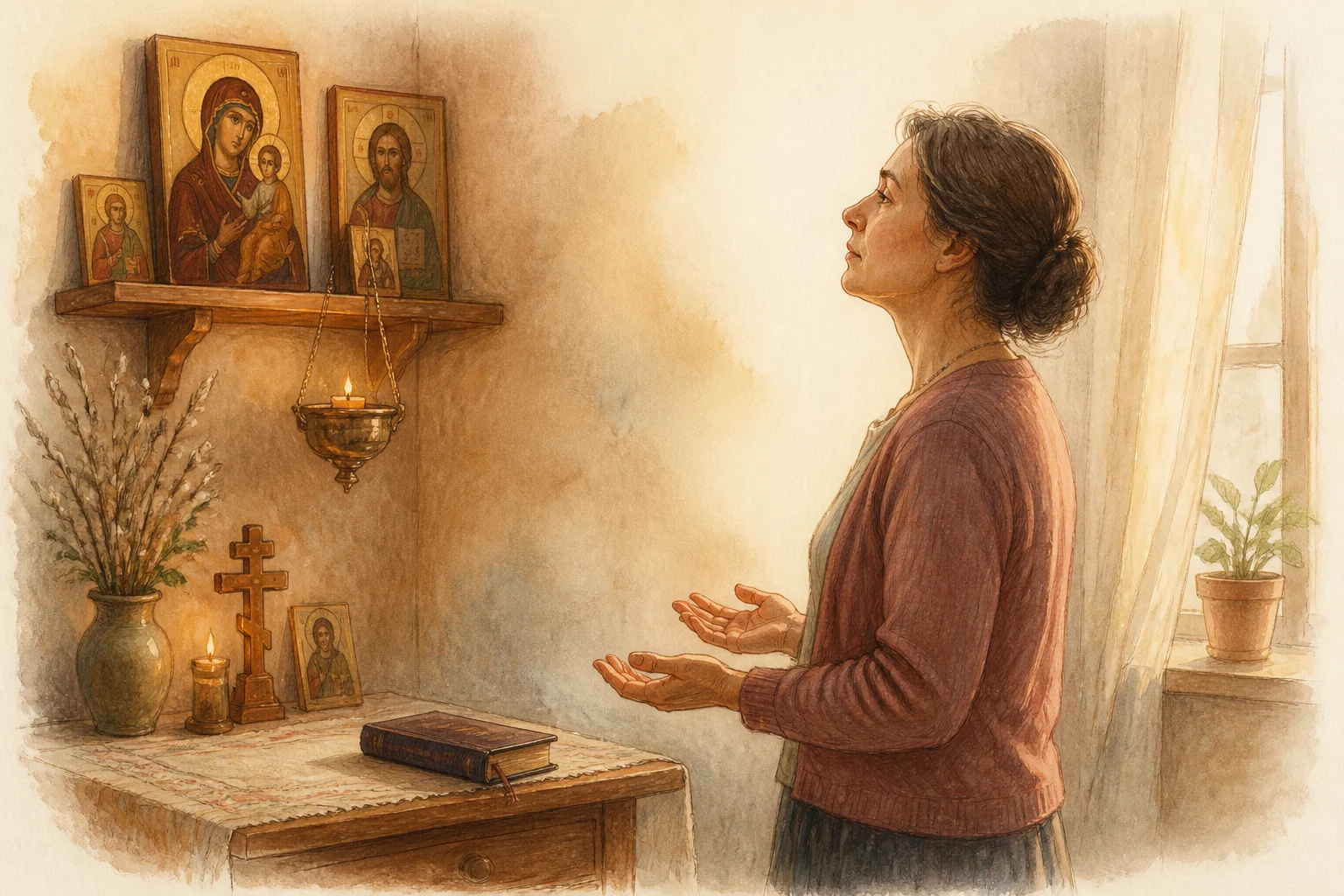
Yes, an Orthodox Christian may pray in his or her own words. You may thank God, ask for help, repent, speak about fear, and pray for other people without using a pre-written text. Personal prayer does not replace the Lord’s Prayer, the Psalms, or the prayers of the Church. The received prayers give direction; your own words help you bring this particular day before God honestly.
The decisive issue is not polished language but attention, trust, and a willingness to live according to what you say. Prayer is neither an incantation nor a technique for making God carry out our plan.
Why people wonder whether it is allowed
A beginner opens a prayer book and finds powerful texts written by saints, unfamiliar expressions, and an established order. Beside them, a simple sentence such as “Lord, I am afraid; help me” may appear inadequate. Some people fear that God hears only canonical formulas or that a badly chosen word could spoil a petition.
That picture turns prayer into a password. Christian prayer is different. God knows the person and the need before a sentence is spoken. Words are needed primarily by us: they help us turn toward God, stop hiding, and open the heart to His answer.
What the Gospel shows
Christ gave His disciples the Lord’s Prayer. It is a pattern that joins an address to the Father with petitions for His Kingdom, daily bread, forgiveness, and deliverance from evil. It orders our desires and remains foundational to Christian life.
The Gospel also preserves brief personal cries: the publican’s plea for mercy, the blind man’s appeal for help, and the father who spoke honestly about both belief and unbelief. These prayers are not literary performances; they are truthful. The Church therefore does not force a choice between “only a written text” and “only spontaneous speech.”
Why the Church gives us written prayers
If we pray only about what worries us at the moment, prayer can shrink into a list of wants. A prayer book widens our vision. It teaches praise, thanksgiving, repentance, remembrance of our neighbors, and a desire not merely for comfort but for salvation.
A received text also supports a person who is too tired or distressed to find words. It connects prayer at home with worship and with the experience of generations of Christians. Unfamiliar phrases should be understood gradually rather than recited mechanically. A good explanation or a conversation with a priest can help.
Why personal words matter
Personal prayer makes it harder to hide behind a page. You can name a conflict, an illness, a fault, a decision, gratitude, or confusion directly. Instead of “help me in general,” you may say, “help me not answer my colleague’s sharp words with cruelty.” Instead of “forgive everything,” say, “I lied and I am afraid to admit it.”
This kind of specificity should lead toward action. If you ask for reconciliation, be prepared to take a peaceful first step. If you pray for someone who is ill, accompany prayer with treatment, practical care, and presence. If you repent, repair the harm where that is possible.
A simple pattern for personal prayer
Begin with the sign of the Cross and a brief address to God. Give thanks for something concrete: a person, a meeting, protection, or the opportunity to begin again. Then name where you were wrong, without excuses and without destroying yourself with shame.
Ask for what you and others need, while remaining open to an answer different from the scenario you prefer. Keep a little silence. End with the Lord’s Prayer, the words “Thy will be done,” or a short thanksgiving. This is not a mandatory formula; it is a practical support for a beginner.
How to combine a prayer book with your own words
You may read a short morning or evening rule, pause after a familiar prayer, and add what matters today. Another approach is to begin in your own words and then read a psalm or the Lord’s Prayer, allowing a personal concern to enter the wider language of the Church.
If you are just beginning, our guide to starting prayer at home explains how to choose a time and place. The article on a prayer rule for beginners will help you avoid taking on an unsustainable amount.
Words you do not need
Do not try to impress God with complicated language. Do not imitate an elevated style if you no longer understand your own sentence. You need not repeat a request in panic because it has not “worked.” Repetition can express faithful persistence, but it is not magical pressure.
It is dangerous to turn prayer into a bargain: “If You do this, I promise that I will…” Do not ask to crush another person’s freedom, force someone to return, punish a rival, or confirm a convenient lie. You may honestly admit that such desires are present and ask for the heart to be purified.
May I speak about anger, fear, and doubt?
Yes. God does not need a pious mask. The Psalms contain grief, loneliness, indignation, and hope. Saying “I am angry” is safer than calling anger righteous and acting from it.
Honesty, however, does not make every desire good. After naming the feeling, ask how to avoid harm, what you need to learn, and where help is required. Severe anxiety, depression, or thoughts of self-harm require professional medical and psychological support alongside pastoral care and prayer, never prayer as a substitute.
What if no words come at all?
Grief, exhaustion, and shock can leave a person able only to remain silent. Silence before God can also be prayer. The sign of the Cross, the name of Jesus Christ, “Lord, have mercy,” or one line from a psalm may be enough.
Do not force yourself to produce an inspiring monologue. You may sit before an icon, breathe, weep, and remember that the Church is praying with you. If the condition continues, ask a trusted person, a priest, and an appropriate health professional for support.
How to pray for another person
Say the person’s name and ask for peace, health, wisdom, and salvation. Do not imagine prayer as remote control. Love respects another person’s freedom, so “make him obey me” contradicts the very purpose of Christian prayer.
You might say, “Lord, protect her, help her see the truth, and teach me to act with love.” Names of the living and the departed may also be submitted for commemoration at church. Upcoming services are listed on our schedule page.
How to teach this to a child
Invite the child to thank God for one good moment, ask for one other person, and finish with the Lord’s Prayer. Do not correct every childlike phrase or turn prayer into a test.
An adult teaches primarily through a calm, undemonstrative example. If a child does not want to speak aloud, you can keep silence together or simply name loved ones. Faith grows in trust, not under the threat of punishment.
How to recognize spiritually unsafe advice
Be cautious when someone offers a “special prayer” guaranteed to bring back a spouse, produce money, or cure every illness after a precise number of repetitions. Orthodox life has no secret verbal mechanism that places God under human control.
Check the source of a text. A prayer copied from a random post may include occult appeals, curses, or serious theological errors. Use a recognized Orthodox prayer book, the Psalter, and the Gospel; show a doubtful text to a priest before adopting it.
When personal prayer becomes self-centered
It is natural to begin with urgent personal needs, but prayer should gradually teach us to see beyond ourselves. Add thanksgiving even on a difficult day. Remember people whose suffering does not benefit you directly. Ask not only for an easier situation but for courage, wisdom, repentance, and the ability to love.
The prayers of the Church are especially valuable here. They prevent a private spiritual life from becoming a closed conversation with our own emotions. Worship, Scripture, confession, and service to neighbors test whether prayer is bearing real fruit.
Frequently asked questions
Must I say “amen” at the end?
You may. “Amen” expresses assent and faithfulness to what has been said, but omitting the word does not make an honest appeal unheard.
May I pray silently?
Yes. Silent prayer is possible while traveling, in a hospital, or beside a sleeping child. At home, reading quietly aloud can sometimes hold attention better.
May I ask about ordinary material concerns?
You may tell God about everything that genuinely concerns you. At the same time, ask for wisdom, honesty, and readiness to receive an answer that differs from your plan.
May a person who is not sure about faith try to pray?
Yes. A beginning can be completely honest: “God, if You are there, help me see the truth.” There is no need to imitate a certainty you do not yet have.
How long should prayer in my own words last?
There is no fixed duration. On one day a single truthful sentence is enough; on another, the conversation may take longer. Faithful regularity matters more than length.
A concise conclusion
You may and should pray in your own words, but personal speech grows best within the life of the Church, alongside the Gospel, the Psalms, and shared prayer. Received texts preserve direction; your own words bring the truth of this day.
If you need help choosing a prayer book or understanding a particular text, contact the parish through our contact page. You can begin today with three simple movements: give thanks, tell the truth, and ask for help to live according to it.