
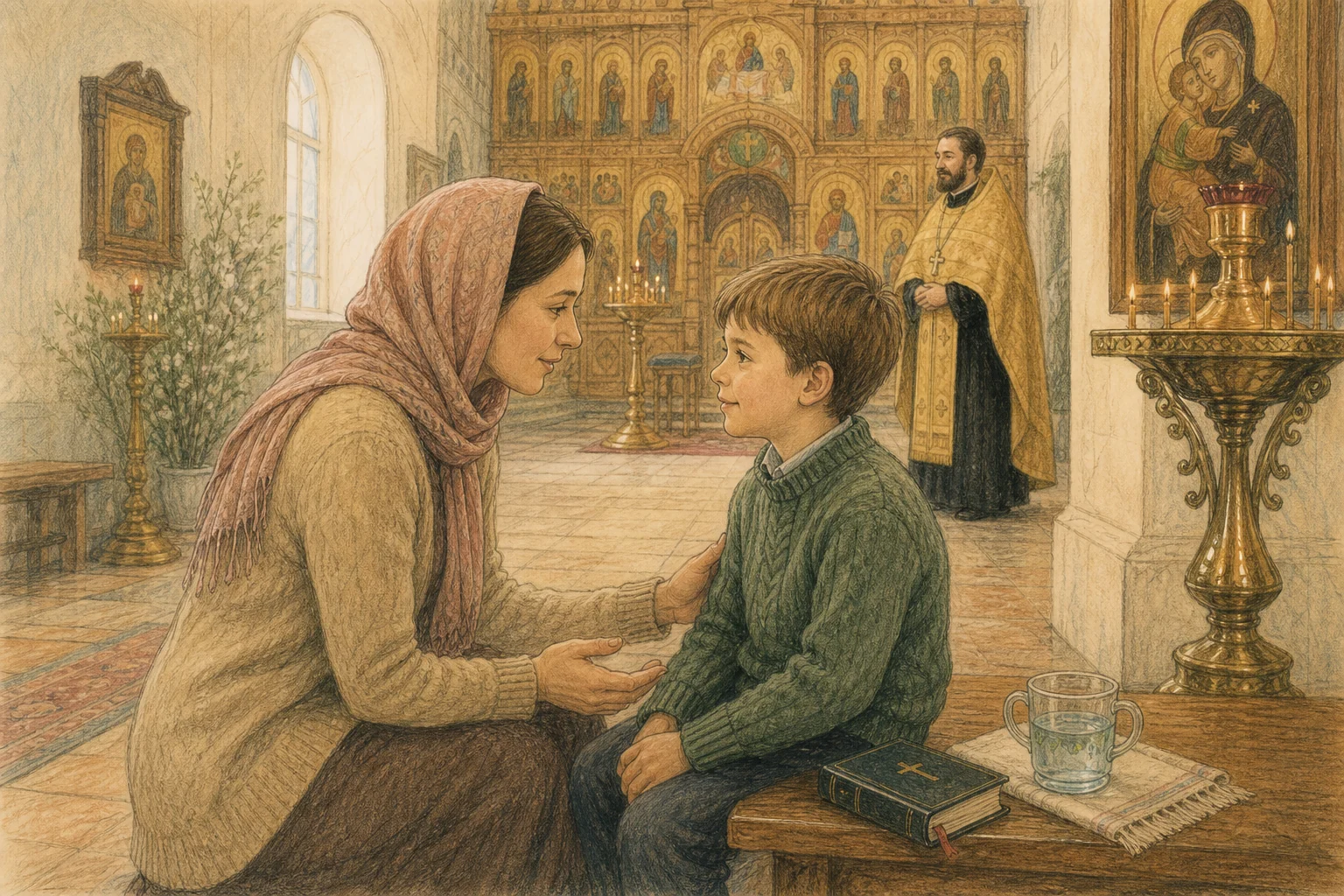
To prepare a child for Holy Communion, explain simply Whom the child is receiving, ask the priest about fasting and confession at that age, allow proper sleep, and arrive without rushing. An infant must not be kept hungry according to an adult rule. A school-age child gradually learns prayer, attention, and responsibility. Illness and medical restrictions must always be considered.
The goal is encounter with Christ and participation in the Divine Liturgy, not flawless behavior performed for the people watching.
What Communion means for a child
In the Eucharist, Orthodox Christians receive the true Body and Blood of Christ under the forms of bread and wine. A child does not need a graphic explanation or a philosophical definition. It is enough to say, “We are going to Christ, who loves us and unites us with Himself.”
Communion is not a prize for silence and not a device for making a child obedient. It is a gift of the Church received with faith and thanksgiving.
Preparing an infant
An infant receives Communion without confession and without an adult fast. Discuss the last feeding with the priest in light of age, routine, diagnosis, and travel. Never create dehydration, hypoglycemia, or severe distress merely to satisfy a time chosen without guidance.
Bring a cloth, spare clothes, and normal care supplies. Come at the point in the service recommended by the parish if the infant cannot remain for its entire length.
Preparing a preschool child
The day before, explain where the family is going, mention the priest by name, and show from a distance or a suitable picture how people approach the Chalice. Avoid excessive detail and do not promise sweets as payment for “good behavior.”
Pray briefly together, ask forgiveness after family conflict, and choose comfortable clothing. Food arrangements are individual; an adult discipline is not imposed automatically on a young child.
Preparing a school-age child
An older child may read several prayers, remember someone with whom reconciliation is needed, and participate consciously in part of the service. The rule should be understandable and attainable, not a copy of a parent’s complete preparation.
Explain the connection with daily life. We cannot ask for union with Christ while deliberately humiliating a classmate. Repentance includes a concrete attempt to repair harm.
Is confession required?
Infants and young children receive Communion without confession. The first confession should not be determined by one number without considering maturity. Russian practice often begins around the early school years, but the priest and family make the pastoral judgment.
Do not lead a child unexpectedly to the analogion without understanding. Our guide to preparing for first confession helps prevent fear.
How long should a child fast?
There is no one duration for every age. The measure develops gradually: first a short period before the Chalice, later a more conscious discipline. Health, medication, diabetes, nutritional needs, and a clinician’s instructions matter.
Do not compete with other families or conceal a medical condition. The priest can give an economia; fasting serves the encounter and must not cause harm.
Must every pre-Communion prayer be read?
The complete adult rule is large for a child. Select several understandable prayers or brief portions with the priest’s guidance. Explain one phrase and pray attentively.
The amount grows over time. Reading together can help when it does not become a late-night marathon and family conflict.
The evening before
Avoid overstimulating entertainment, a late bedtime, and frantic preparation. Set out clothes and supplies, check the Liturgy time, ask one another’s forgiveness, and read a short prayer.
If an argument occurs, do not cancel everything as punishment. Reconcile as far as possible and speak with the priest about a serious unresolved matter.
What to say in the morning
Do not begin with a threat: “If you make noise, God will not receive you.” Say that the family is going to thank God and meet Christ. Remind the child of the practical sequence calmly and only as much as needed.
If the child asks about food, explain the agreed measure without shame. Adults should also prepare honestly rather than imposing rules only on the child.
What the child should wear
Choose clean, modest, comfortable clothing that does not constrict the neck. Remove a bulky scarf, hood, or accessory that interferes with a safe approach. Tie long hair back.
A formal outfit that makes the child hot or unable to move is unnecessary. Comfort supports attention.
When to arrive
A child should gradually learn to participate in the Liturgy rather than being brought only for its last minute forever. Yet a whole long service may be impossible for an infant or a child with additional needs. Agree on a reasonable stage of growth.
Check the schedule, arrive with time to settle, and stand where a quiet exit is possible. Do not respond to lateness by pushing through people toward the Chalice.
How to approach the Chalice
Follow the attendants’ guidance. State the child’s baptismal name clearly, help the child open the mouth calmly, and do not make a sudden sign of the Cross directly in front of the Chalice. Hold an infant securely in a position convenient for the priest.
After reception, an attendant wipes the lips; zapivka and blessed bread are given when age permits. The parish will show the local order.
If the child is afraid or refuses
Do not force the mouth open or shame the child before the line. Step away, settle down, show the parent’s peaceful example, and ask whether another attempt is appropriate. Visiting the church outside a crowded service can create familiarity.
One unsuccessful approach is not a spiritual disaster. Trust matters more than coercion.
Sensory needs and disability
Noise, incense, a crowd, contact with the spoon, and unfamiliar fabric may be difficult. Tell the priest in advance what helps: a shorter wait, a familiar adult, a quiet space, or a visual sequence.
Do not force the child to hide distress. Organization can be adapted without changing the sacrament’s meaning.
Allergies, medication, and chronic illness
For severe allergy, celiac disease, diabetes, swallowing difficulty, or regular medication, speak beforehand with both a qualified clinician and the priest. Do not experiment at the Chalice or discontinue treatment.
State the precise restriction without demanding an improvised alteration of the Holy Gifts. A pastoral plan should be found before the service.
If the child spits up or vomits
Tell the priest or attendant immediately and calmly. Do not conceal what happened or discard the soiled cloth. Follow their directions while also assessing the child’s medical condition.
Do not accuse the child. A physiological response is not conscious sacrilege.
After Communion
Give thanks, remain for the end of the service and veneration of the cross when the child can manage it, and keep a peaceful day at home without banning ordinary play.
Briefly remember together what occurred. Our article on what to do after Communion provides additional guidance.
The role of parents and godparents
A child learns less from instructions than from seeing adults pray, confess, approach the Chalice without performance, and treat people more kindly. Godparents may accompany but cannot replace the parents.
Do not argue about rules in front of the child. Resolve differences calmly through the parish contact page.
Frequently asked questions
May the child brush teeth in the morning?
For a young child, hygiene and the risk of swallowing water should be considered by age; ask the priest about parish practice.
May medicine be given before Communion?
Necessary medication must not be stopped independently. A clinician sets the regimen, and the Communion order is agreed with the priest.
What if the child ate accidentally?
Tell the priest honestly. He will decide according to age and circumstances; do not teach a child to hide the fact.
Must the child stand through the entire Liturgy?
Participation grows gradually. Age, health, and development matter, though worship should not remain permanently reduced to one minute at the Chalice.
May a gift be promised for receiving Communion?
Avoid turning the sacrament into a bargain. A family may celebrate peacefully afterward, but the motive should not be payment for compliance.
A short checklist
Contact the priest; clarify food, confession, and prayers; disclose health needs; sleep adequately; prepare comfortable clothing; arrive early; never coerce at the Chalice; and give thanks afterward.
Calm, age-appropriate preparation helps a child meet Christ without hunger, humiliation, or fear.