
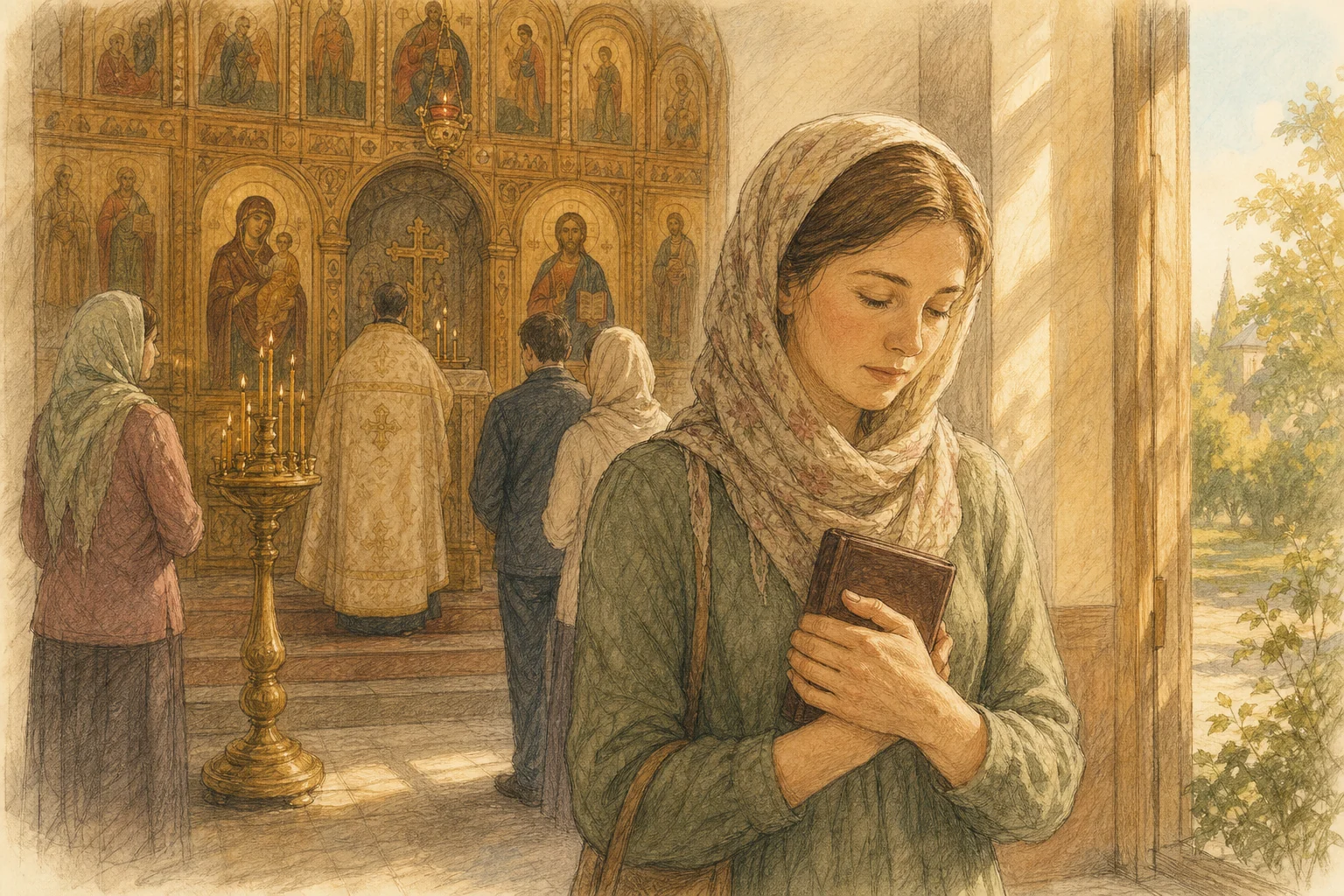
After Holy Communion, it is best to remain until the end of the Divine Liturgy, thank God, listen to or read the prayers of thanksgiving, and live the rest of the day with greater attention to your words and actions. This is not a set of magical restrictions. The purpose is to receive the gift with reverence and carry it into peaceful, sober, active Christian life.
Parish customs differ. In some churches the thanksgiving prayers are read immediately after the service; elsewhere people read them at home. If you do not know the local practice, simply ask a church attendant or the priest.
Remain until the service has ended
After receiving, return quietly to your place, continue listening, and wait for the dismissal. The Liturgy does not end for an individual at the moment he or she approaches the Chalice. The whole community continues its common act of thanksgiving.
A real need may require you to leave: you may become ill, need to care for a child, or have to take urgent medicine. This does not erase the sacrament. Do what is necessary without panic and continue your thanksgiving wherever you safely can.
Receive the warm wine and antidoron without anxiety
In many parishes, communicants receive a small amount of warm diluted wine and antidoron after the Chalice. This helps them swallow the Holy Gifts reverently and belongs to local liturgical custom; it is not a second sacrament. Follow the order of the particular parish.
Do not push or search for a supposedly special piece of bread. If alcohol, heat, or bread is unsafe for you, tell the priest beforehand. Medical safety and reverence are not enemies.
Thank God
The prayers of thanksgiving after Communion keep the event from disappearing into ordinary haste. When they are read aloud in church, it is good to stay and listen. If there is no common reading, you may use a prayer book at home.
If you have little strength, speak simply: “Lord, I thank You; help me keep peace and live according to Your will.” A short attentive prayer is better than a long text read with fear and irritation. Our guide on beginning prayer at home offers a gentle way to build that habit.
Must I feel something extraordinary?
No particular emotion is required. One person feels consolation, another quietness, and another remains tired. Grace is not measured by warmth, tears, lightness, or an unusual bodily sensation.
Do not inspect yourself every minute to see whether you are reverent enough. Look instead for fruit: are you becoming more patient, truthful, and attentive to another person? Even after Communion, a human being still freely chooses how to act.
May I eat and drink?
After the Liturgy you may have ordinary food and water unless another fast or a medical restriction continues. The Eucharistic fast has ended with reception of Communion. During a longer fasting season, follow the food discipline appropriate to that season and your health.
Do not turn a meal into an object of fear. It is more important not to compensate by overeating and not to lose thanksgiving. The article on the meaning of Orthodox fasting distinguishes spiritual purpose from a menu alone.
May I brush my teeth, wash, or take a shower?
Yes. Normal hygiene after Communion is permitted. There is no universal Church rule forbidding water, washing, or brushing one’s teeth for the entire day. Reverence does not require neglect of the body.
Immediately after the Chalice, communicants normally receive the warm drink and avoid unnecessary disturbance of the mouth. Later, act reasonably. If a dental procedure may cause bleeding, discuss its timing with both the priest and dentist when possible, but never postpone urgent treatment.
May I kiss icons or my family?
Yes. The claim that a communicant may not kiss an icon, a child, or a spouse is not a universal doctrinal prohibition. A local suggestion to avoid immediate kissing may express caution just after receiving the Gifts, not the belief that a communicant has become a dangerous sacred object.
Love for your family does not defile Communion. At the same time, no one is required to display affection. Remain peaceful and respect another person’s boundaries.
Work, travel, and ordinary responsibilities
If possible, do not fill the remaining hours with noise, entertainment, and endless scrolling. Yet work, caring for a relative, traveling, studying, or completing household duties do not in themselves contradict Communion.
The goal is not to create a sterile day. It is to do the ordinary in a different manner: without contempt, profanity, irritation, or indifference. Choose one small work of love, such as calling someone who is lonely, helping at home, or taking the first step toward reconciliation.
If an argument happens after church
Communion does not remove human freedom or guarantee a day without temptation. If you lose your temper, stop, acknowledge your responsibility, and ask forgiveness. Do not say that everything is now ruined; that thought merely turns one fall into permission to continue.
A brief prayer, a pause, and a concrete act of repair are better than theatrical self-condemnation. Repeated severe aggression or abuse requires personal pastoral guidance and professional help, not only a general article.
Medicine and medical procedures
Prescribed medication may and should be taken after Communion. Do not stop treatment out of religious fear. If a dose is required before the Liturgy, ask your physician and priest beforehand how to combine treatment with the Eucharistic fast.
Receive emergency care immediately. Illness does not make a person less faithful, and protection of life is not a failure of reverence.
If nausea or vomiting occurs
First protect the person’s health. If vomiting occurs soon after reception, notify the priest when possible; he will explain the appropriate church practice for the concrete circumstances. Do not attempt unusual procedures copied from anonymous internet advice.
Loss of consciousness, severe pain, bleeding, breathing difficulty, or another dangerous symptom calls for emergency medical care. The pastoral question can be handled after help has been given.
When a child has received Communion
Give the child the customary warm drink or antidoron according to parish practice, provide age-appropriate food, and thank God together in a few peaceful words. Do not demand that a young child sit in silence all day or fear every movement.
The best lesson is the peace of the adults. Do not scold a child for being tired after a long service. See the fuller guide to preparing a child for Communion.
Spitting, seeds, and excessive bodily vigilance
Traditional advice to be especially careful after receiving expresses reverence for the Holy Gifts. After the warm drink, it is reasonable for a time to avoid sunflower seeds, smoking, or anything that predictably leads to spitting. It is not necessary to monitor every drop of saliva for the whole day.
Smoking harms health in any case. Communion may become an occasion to seek help with addiction. Anxious control of the body is not a measure of faith.
How to spend the rest of the day
Choose a simple rhythm: thanksgiving, a peaceful meal, less informational noise, one act of mercy, and attentive presence to those near you. You may read a short Gospel passage without assigning yourself a spiritual marathon.
If the parish has an evening service, community meeting, or volunteer activity, participate according to your strength. Current service times are available in the schedule.
What to do on the following day
Do not try to preserve grace by avoiding life. Remember what was revealed in Confession and take one promised step: repay a debt, stop a lie, make a medical appointment, remove access to a destructive habit, or ask forgiveness.
A regular church life matters more than an occasional emotional peak. Discuss the frequency of Communion and your rule of preparation with a priest who knows your circumstances.
Common questions
Must I read every prayer of thanksgiving?
The prayers are a good and established practice, but illness, care of a child, disability, or another real need may change the form. Give thanks attentively in the measure available to you and ask your priest about a stable personal rule.
May I sleep after Communion?
Yes, especially during illness, pregnancy, night-shift work, or serious fatigue. Sleep does not defile the sacrament. If you have strength, offer a brief prayer of thanks first.
May I take tablets or other medicine?
Yes. Follow medical instructions and do not delay a necessary dose without your physician’s approval.
What if I felt no joy?
Do not call the Communion unsuccessful. Emotions change. Remain faithful through prayer, reconciliation, honesty, and works of love.
May I go to work or visit friends?
You may work. Judge a social event by its content: peaceful fellowship is compatible with the day, while drunkenness, cruelty, and loss of self-control contradict Christian sobriety on every day.
The essential point
After Communion, remain until the service ends, follow the parish order, thank God, and live more attentively. Do not measure the sacrament by emotion or gather random prohibitions from the internet.
When health, medication, or an unusual situation requires an individual decision, contact the parish through our contact page. A calm question is better than an anxious guess.