
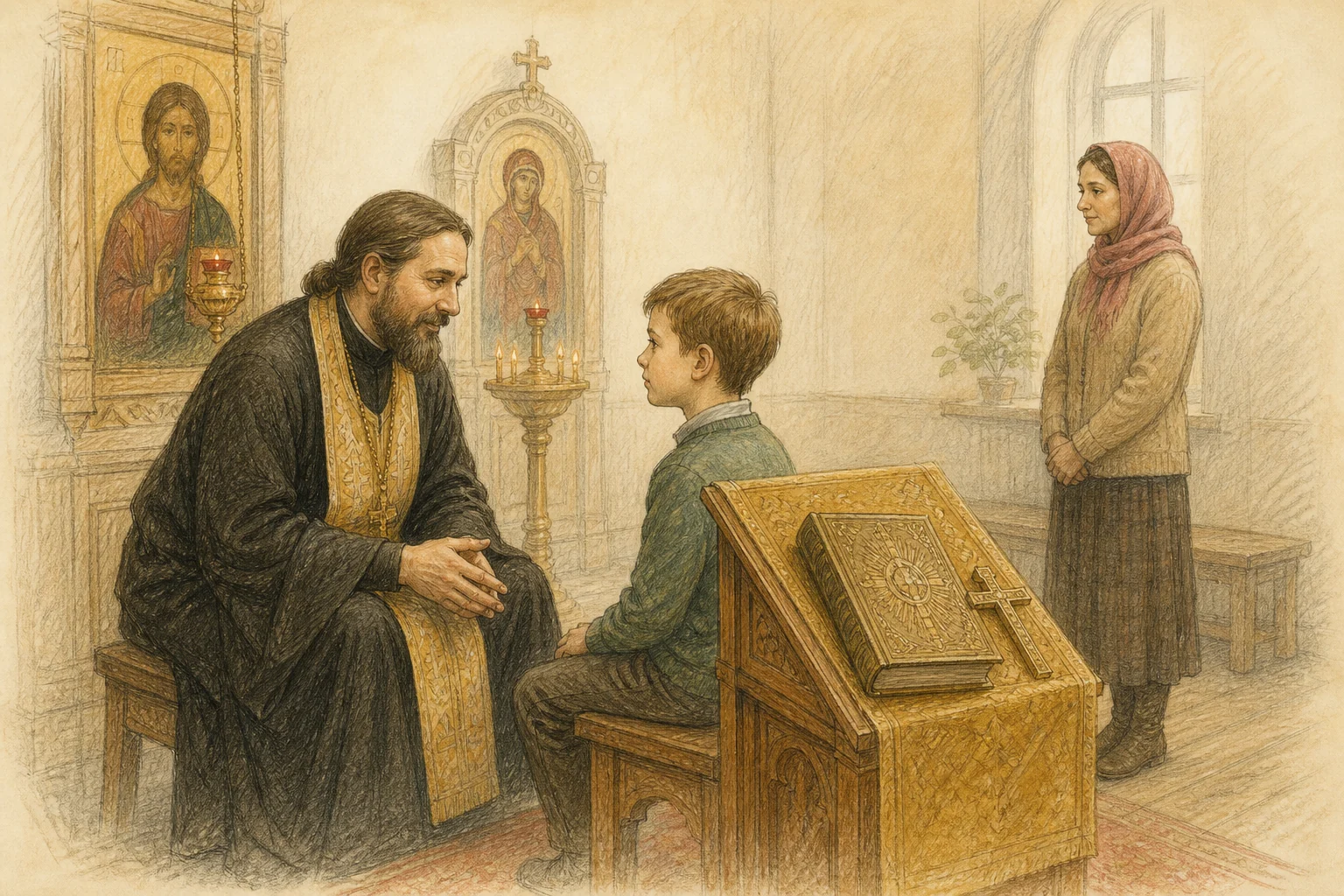
Prepare a child for first confession calmly: explain that the child tells God the truth about deliberately harmful actions, while the priest helps and reads the prayer of absolution. Do not compose the confession, rehearse the “correct sins,” or demand a report afterward. Introduce the priest beforehand and choose a time without a long line.
Readiness is not defined by one birthday. Russian parish practice often begins around seven years of age, but understanding of responsibility and pastoral judgment matter more than the calendar.
How to recognize readiness
The child can distinguish an accident from a chosen act, say in personal words “I did this and I am sorry,” and understand a basic difference between a mistake and deliberate harm. It is also helpful if the child can speak briefly without a parent supplying every answer.
If the child only repeats adult phrases and does not know why he or she is standing at the analogion, preparation should continue. The priest can help choose the moment without comparison with other children.
Confession in simple language
Say, “In confession we tell God honestly where we chose falsehood or hurt someone. The priest listens as a witness of the Church, gives guidance, and prays for forgiveness.”
Do not say that the priest will “find out everything” or that God is waiting to catch the child. Confession is a return to love and truth, not interrogation.
What is a sin and what need not be listed?
Sin involves free consent to evil: deliberate lying, cruelty, stealing, ridicule, or refusal to repair harm. A difficult mood, fear, fatigue, diagnosis, an accidentally broken cup, and an unwanted thought are not automatically sins.
Help the child see responsibility without labels such as “you are lazy” or “you are bad.” Ask instead, “Did you understand what you were doing? Who was hurt? What can be repaired?”
A conversation one week beforehand
Choose a normal peaceful moment, not the evening after punishment. Speak about your own confession without revealing details: adults also make wrong choices, admit fault, and need God’s mercy.
Show the place in church and explain that a Gospel book and cross will be present and that the priest may place the epitrachelion over the head during the prayer. Predictability reduces fear.
Choosing the priest
When possible, approach a priest the child has seen and the family trusts. Tell him in advance that this is a first confession, mention age, communication needs, and severe anxiety without disclosing the content for the child.
Do not search for the strictest priest “to teach a lesson.” Pastoral work helps the child encounter mercy and responsibility together.
Should the parent stand beside the child?
A parent brings the child, but the conversation normally takes place without the parent listening, at a respectful distance. This protects freedom and prevents the sacrament from becoming an extension of family surveillance.
If a young child, disability, or communication need requires assistance, agree on the arrangement beforehand. Support must not become supplied answers.
May the child make a list?
A child who writes and fears forgetting may note two or three actions in simple words. A parent must not edit the list or add accusations. The page is a memory aid, not a complete report on the child’s personality.
If writing increases anxiety or endless checking, leave it aside. Our article on written preparation for confession explains healthy boundaries.
Questions a parent may ask
Open questions are useful: “What would you like to ask forgiveness for? Whom did you hurt? What did you do while knowing it was wrong? What can you repair?” Do not turn the response into cross-examination.
Do not implant sins the child did not name or demand an admission merely to soothe an adult. A false confession does not form conscience.
What to read beforehand
A brief prayer for honesty and mercy, the Lord’s Prayer, and one Gospel scene about repentance are enough. A long adult preparation can be excessive.
The amount grows gradually. Our guide to a prayer rule for beginners helps distinguish spiritual seriousness from page count.
What happens during a first confession?
The child approaches an analogion with a cross and Gospel book, names the chosen wrongs, and listens to brief guidance. The priest then reads the prayer of absolution, placing the epitrachelion over the head according to the rite.
Organizational details vary. Do not photograph or record the conversation, stand close enough to hear, or rush the child.
If the child remains silent
Silence may express fear, fatigue, or lack of understanding rather than defiance. The priest may ask a few simple questions or suggest becoming acquainted first and returning another day.
Do not independently threaten exclusion from Communion or punishment. Discuss the next step after the service without public shame.
If the child cries
Allow time to settle, offer water, and stay available at a respectful distance. Do not say “there is nothing to fear” irritably. Acknowledge the feeling: “You are worried; I am nearby.”
If a particular interaction was harsh or frightening, listen and raise the concern with the responsible clergy. Trust cannot be ordered into existence.
Confidentiality and child safety
Explain that a parent will not demand a list of sins or turn the conversation into family news. At the same time, the child must know that if an adult causes pain, makes threats, asks for secret touching, or creates a dangerous secret, a safe adult must be told immediately.
Religious conversation does not replace safeguarding. A disclosure of abuse requires securing safety and contacting competent authorities and qualified professionals; never leave the child alone with the person alleged to have caused harm.
Autism, ADHD, and speech differences
Tell the priest about communication style, sensory load, and the need for additional time. A few familiar pictures or a brief written response may be used when that helps the child communicate personally.
Lack of eye contact, movement, or literal speech must not be mistaken for disrespect. The goal is an accessible sacrament, not forced masking.
Is confession required before every Communion?
The priest determines the connection and frequency for a child according to age and parish practice. Parents should not impose “never Communion without confession” independently or dismiss confession as unnecessary.
Our guide to preparing a child for Communion helps establish the whole rhythm without pressure.
What to do afterward
Do not ask, “Did you tell everything?” or evaluate the length. Say that you are glad the child was honest and are ready to help repair specific harm if the child asks.
The day should become neither an examination celebration nor punishment. Remain peaceful, participate in the Liturgy, and give thanks.
How parents form conscience
Admit your own faults to the child: “I shouted; that was wrong; please forgive me.” The child then sees that repentance does not destroy dignity and is not a tool reserved for younger people.
Do not use something accidentally overheard as ammunition in a later argument. A home where truth is received safely prepares for confession better than lectures.
When professional support is also needed
Confession is not treatment for trauma, obsessive-compulsive symptoms, depression, or a developmental condition. A child may need both pastoral care and a qualified clinician, with adults coordinating safely and respecting privacy.
Repeated panic, self-harm statements, loss of daily functioning, or disclosure of abuse requires prompt professional action. Do not increase religious demands as the only response.
Frequently asked questions
Must every child wait until exactly seven?
Seven is a common reference point, not an automatic date. Readiness and the priest’s judgment matter more than a birthday.
May the child read from a note?
A short memory aid is possible when it supports personal speech and does not become a compulsive exhaustive register.
Should a parent tell the priest about misbehavior?
Not as a method of forcing an admission. A safety concern or relevant condition may be shared separately while preserving the child’s dignity.
May the child confess to another priest?
Yes. A familiar pastor may be easier for the first time, but the child should not be forced toward someone he or she reasonably fears.
What if the child says there are no sins?
Do not invent a list. Continue teaching about freedom, harm, and forgiveness, and ask the priest to help assess readiness.
A short plan
Speak without threats; explain the meaning; choose a familiar priest and quiet time; help the child remember a few actions; step away for privacy; demand no report; and support repair afterward.
Use the parish contact page to arrange a conversation. A good first confession teaches a child not to fear truth or God’s mercy.