
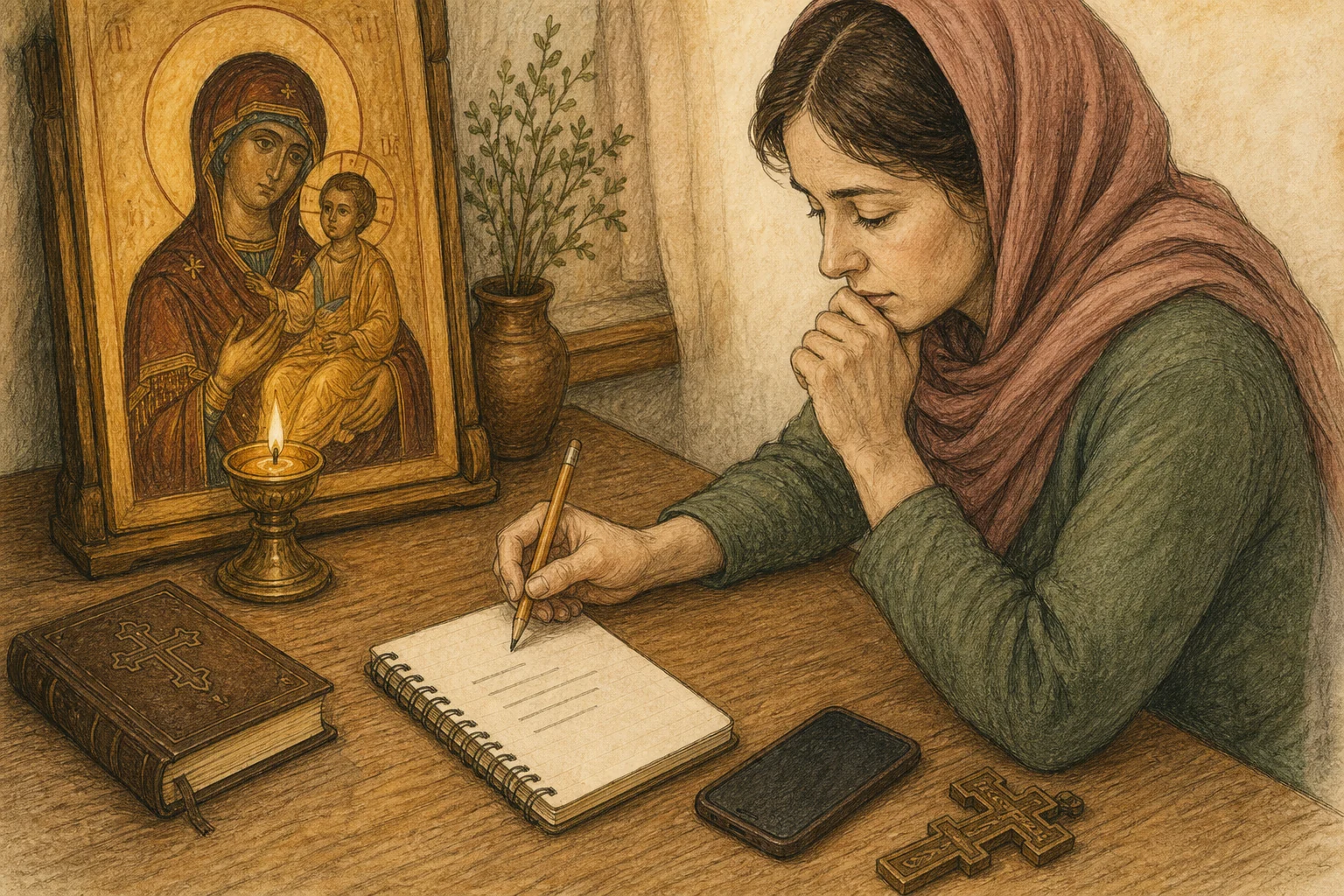
Yes, sins may be written briefly before confession and the page may be consulted so that the main matters are not forgotten. The note is an aid, not a required part of the sacrament or a document that must be read word for word. Several concrete actions and continuing problems are better than dozens of pages of general accusations.
In confession, a person speaks to God about personal responsibility in the priest’s presence. The list must not become an account of everyone else’s faults or an attempt to achieve perfect certainty that no thought was missed.
Why write anything?
Anxiety at the analogion can disrupt memory, especially after a long absence. A short outline helps name the grave matter first, avoid turning to autobiography, and prevents remembering the central point only on the way home.
Writing helps someone who naturally structures thoughts, has a memory difference, or is afraid to speak. It serves the conversation rather than replacing it.
Is a list required?
No. You may prepare in prayer and speak in your own words. The Church does not require an identical method from everyone, and absence of paper does not make confession less complete.
If a list produces more anxiety than clarity, leave it. The priest can ask questions and help move through the main areas.
What is a reasonable length?
One small page or several points is ordinarily enough. After many years, thematic groups may be useful, but preparation should not become an essay occupying several days.
Set a limit, perhaps thirty minutes. Then pray and stop editing. Repentance continues in action, not endless polishing of the text.
How to write concretely
Record the action and your choice: “I lied to avoid responsibility,” “I insulted someone close and refused to apologize,” or “I continue an addiction and conceal it.” “I am guilty of pride” may begin the thought, but a manifestation is more useful.
Literary beauty and a specialized term for every case are unnecessary. Ordinary truthful words are clearer than a borrowed catalog copied from a booklet.
Write about yourself, not a case against others
“My husband made me do it” describes him. A more personal statement is, “I answered with humiliation and continue to desire revenge.” Give context briefly where it affects freedom or safety, then return to your own choice.
Avoid full names and unnecessary details of another person’s private life. Confession is not a trial of someone absent.
Action, feeling, and thought differ
Anger may arise without consent; deliberate cultivation of hatred and action from it involve the will. An intrusive frightening thought is not identical to desire or action. Fatigue and a symptom of illness are not automatically moral guilt.
Ask while writing: what appeared involuntarily, to what did I consent, and what did I do? This protects conscience from both excuses and false guilt.
Must the number of occurrences be listed?
Exact arithmetic is rarely needed, but scale can matter. “Once,” “regularly for several months,” or “almost daily” may reveal a pattern.
Do not spend hours reconstructing each episode. The priest will ask about frequency or circumstances when necessary.
How to name an intimate sin
Name the kind of act clearly but without graphic detail, names, or an attempt to shock. Do not hide a serious matter in a vague phrase, while preserving the dignity of yourself and others.
If words are difficult, begin, “This is hard to say, but it concerns…” The pastor can help establish an appropriate level of description.
What belongs at the top?
Begin with what you most want to hide: a grave deliberate act, continuing addiction, violence, deception, or conscious break from Church life. Then move to persistent daily patterns.
This prevents anxiety from leaving the central matter until time is gone. Do not use dozens of minor points as a screen before something serious.
A repeated sin
Write it again if it truly recurred. Add what you attempted after the previous confession and what continues to support the habit. Do not conceal it from shame or repeat it mechanically without a new decision.
A useful point might say, “I fell again; I am ready to remove access and seek help.” A concrete plan shows the direction of repentance.
May the whole list be read?
You may look at it and read the points. Pause, listen to questions and counsel, and do not use the page to avoid a living conversation. The priest may ask for a shorter account or clarification.
If the preparation is long and time is limited, say so immediately and ask whether a separate appointment is needed.
May a phone be used?
A digital note is technically possible, but paper is normally safer for attention and privacy. A phone can display notifications, sync to cloud backups, or reveal the note accidentally.
If a device is needed because of disability, use airplane mode, large type, and local protection. Never make an audio recording of confession.
How to keep the list before confession
Do not leave it on a shared table or send it to a family chat. Put the page inside a closed prayer book or envelope. For a digital note, use local protection and avoid unnecessary copies.
Privacy does not mean secretly continuing dangerous behavior. When another person is at risk, establish safety and seek competent professional help.
What to do with the page afterward
You may tear it up and dispose of it so that no one can read it, or preserve only assigned practical steps separately. The priest is not required to take or burn the paper.
Do not imagine that sins inhabit the sheet as a physical substance. Absolution is connected with repentance and the Church’s prayer, not the destruction of ink.
If a point was forgotten
A sincerely forgotten matter does not make confession invalid. If a serious sin returns to memory later, name it next time and do not deliberately conceal it.
Do not return immediately because of every doubtful phrase. Trust the prayer of absolution and follow pastoral guidance.
A list for a child’s first confession
A child may write two or three simple points independently. A parent must not add items or inspect the confession afterward. If writing creates fear, it is unnecessary.
Our guide to a child’s first confession explains the safe role of adults.
When a list signals compulsion
Warning signs include dozens of rewrites, attempts to list every thought, repeating confession because one word felt wrong, and fear of catastrophe after an omission. This may be a religious form of obsessive-compulsive disorder.
Tell both the priest and a qualified mental health professional. Helpful boundaries include one preparation period, one regular pastor, and no repeated checking.
A simple outline
Divide the page into four questions: what have I done against God and faith; whom have I hurt; what harm continues; and what can I begin to repair? Leave only several concrete points under each.
The outline need not capture everything. Pray, take it, and come. For a longer absence, read our guide to returning to confession.
Frequently asked questions
Must the page be handed to the priest?
No. You may read it yourself. Give it only by agreement and do not expect mandatory storage or destruction.
May I print an online “list of sins”?
It may suggest a subject but cannot replace personal examination. A borrowed exhaustive catalog often creates false guilt and formal language.
Should I record the sins of my parents or spouse?
No. Name your own response and choice. Another person’s dangerous behavior should be discussed separately for safety and guidance.
Is confession valid if the list was not finished?
The sacrament is not measured by the number of spoken lines. Do not consciously conceal something grave, answer questions, and trust the Church’s prayer.
May the note remain as a journal?
Keep it only when it supports change and is securely protected. If it feeds shame and checking, destroy it.
The central point
Writing is allowed: keep it brief, concrete, personal, and directed toward memory. The page is optional, does not physically carry sin, and must not become a compulsive report.
If the list already consumes hours or causes panic, stop and seek help through the parish contact page and an appropriate professional.