
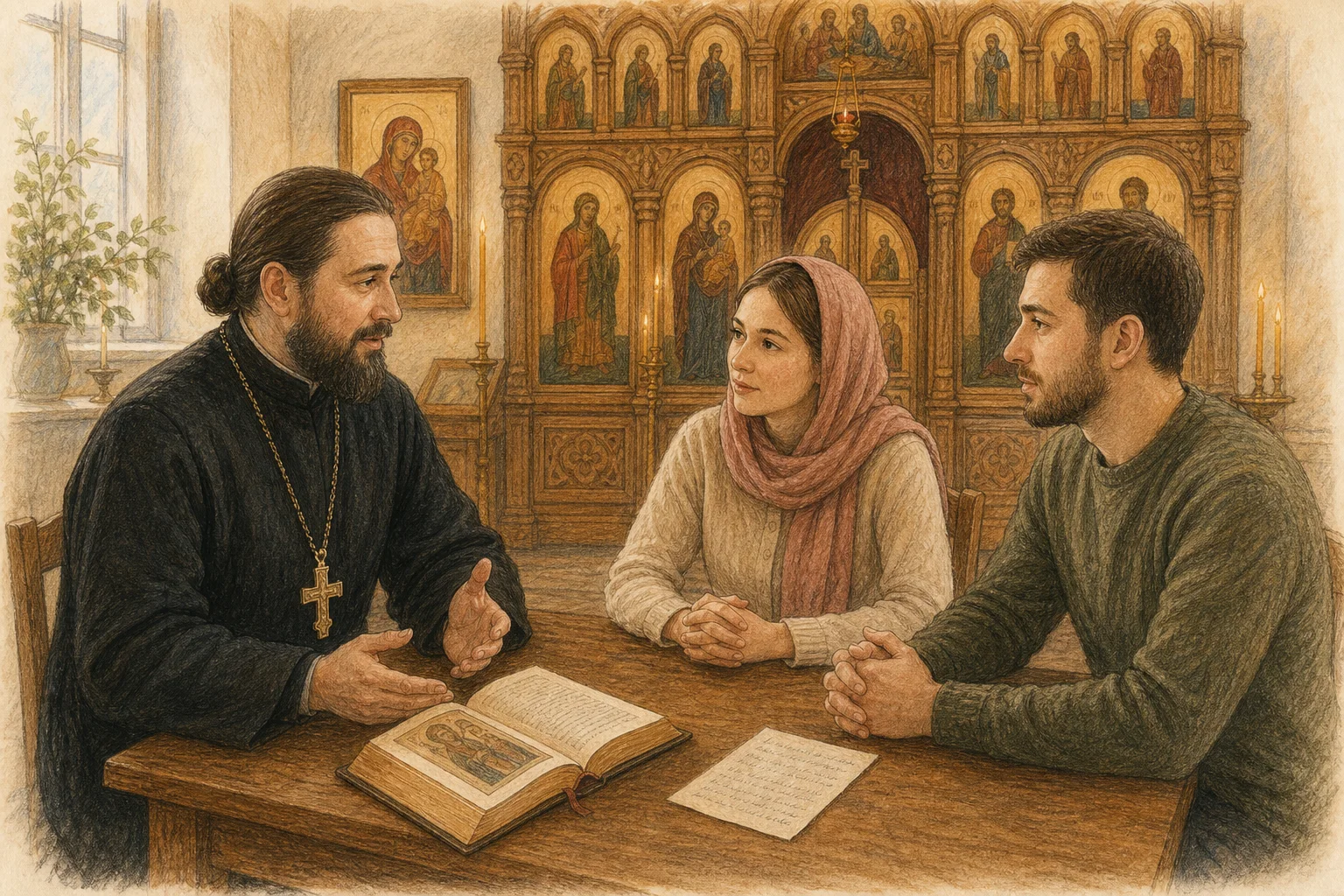
Catechetical talks are not an examination or a formality before choosing a Baptism date. They are an opportunity to meet the faith, understand the Mystery and calmly ask the questions that do not fit into a short checklist.
The parish may invite an adult preparing for Baptism, parents of a child and future godparents. The number, time and format of meetings belong to local practice, so confirm them in advance.
Why these talks matter
Baptism is the beginning of life in the Church, not something done “just in case”. A conversation helps people see prayer, the Divine Liturgy and responsibility behind practical preparation.
What is usually discussed
Each parish has its own approach, but meetings commonly address the Gospel, the Creed, Baptism and Chrismation, common prayer and participation in the Liturgy. You do not need to pretend to be experienced; an honest beginning is enough.
Who should take part
For an adult, the talks support a conscious decision. For parents and godparents, they help ensure that their role continues after the day of Baptism. If someone cannot attend, contact the parish in advance rather than assuming an answer.
How to prepare without anxiety
- Confirm the date, place and length of the meeting.
- Write down questions about preparation, a baptismal name, godparents and first steps afterwards.
- Read a passage from the Gospel—not for a test, but to make the conversation more alive.
- Do not invent “correct” answers; sincerity is more valuable than memorised phrases.
If a child is being baptised
Godparents pray for the child, help the child grow into faith and remain close as trusted adults. Read also guidance for parents and godparents and how to choose godparents.
Why preparation is more than a date and a checklist
It is natural for a family to begin with a date, a cross, towels or photographs. Such things may be practical, but they are not the meaning of the Mystery. Baptism welcomes a person into the life of the Church: prayer, worship and a community that learns to live not only for itself.
A catechetical conversation makes room for real questions: “I know almost nothing,” “I feel awkward in church,” or “I am afraid of doing something wrong.” Those are often the beginning of an honest conversation, not a barrier to it.
If an adult is preparing for Baptism
An adult comes with a personal story—perhaps a long search, a difficult period or a desire to begin again. You do not need to prove that you are already “good enough” or know every answer. What matters is a free decision and a willingness to continue after the day itself.
Ask how the parish supports a new Christian afterwards: where to begin with worship and the Gospel, how to meet the community and whom to approach with a personal question.
The Creed is not a text to recite mechanically
Preparation often includes the Creed: the Church’s concise confession of faith in the Father, Son and Holy Spirit, in the Church, Baptism, resurrection and life to come. It can be learned gradually. More importantly, a person begins to understand what they are trusting.
Parents and godparents: not a one-day role
Godparents do not replace parents and are not a guarantee of good fortune. They pray for their godchild, remain close and help the child discover faith. An honest “I am still learning” is better than a beautiful promise forgotten after the celebration.
What happens on the day
The general course of the Mystery is normally explained: the renunciation of evil and confession of faith, the blessing of water, Baptism, Chrismation and clothing in white. The priest explains the actual order; an online article cannot replace that conversation.
A child may cry and an adult may feel uncertain. A perfect performance is not required for a meeting with God.
What follows is most important
After Baptism, ordinary life becomes the place of growth: a short prayer, reading the Gospel, the Sunday Liturgy, mercy and learning to ask forgiveness. Choose one calm next step rather than trying to master everything at once.
Questions people ask
Do I need to know everything about Orthodoxy already?
No. These talks are a beginning; a willingness to listen and ask is what matters.
May I ask personal questions?
Yes. If a question needs privacy, ask for a conversation with the priest after the shared meeting.
Next step
Check the service schedule and use the parish contacts to confirm the current preparation. A calm conversation is already a good first step.