
Pascha is the feast of Jesus Christ’s Resurrection from the dead, the foundation of Christian hope, and the greatest day of the Orthodox church year. Death remains a biological reality, but Christ has passed through it, broken its dominion, and opened human life to communion with God.
Paschal bread, colored eggs, the midnight procession, and a family meal express joy but do not replace the feast’s content. Pascha begins not in the kitchen or an exchange of greetings but in the liturgical encounter with the risen Christ.
What does the word “Pascha” mean?
The name is connected with the Old Testament Passover, the passage from slavery to freedom. For Christians, Christ is the true Pascha: through His death and Resurrection humanity is led from the dominion of sin and death into life.
Pascha is therefore more than the anniversary of an extraordinary event. The Church speaks in the present tense, entering the joy of the Resurrection and choosing life according to the Gospel again.
Why the Resurrection is the center of faith
Without the Resurrection, the Cross could be understood only as the tragic execution of a righteous man. The Resurrection reveals that God’s love is stronger than death and that the crucified Jesus is truly Lord.
Christian hope does not promise an absence of pain. It proclaims that illness, injustice, bereavement, and the grave do not receive the final word.
Pascha and the Twelve Great Feasts
Pascha is not counted among the Twelve Great Feasts because it stands above them as the “Feast of Feasts.” The entire movable cycle of the church year depends on its date.
Our guide to the Twelve Feasts and the church year explains the relationship. Nativity and every other major feast reveal the mystery of Christ, but Paschal light brings them into one whole.
Why the date changes
Orthodox Pascha is calculated according to the church Paschalion and is connected with the spring full moon and Sunday. Its civil date therefore changes each year.
Do not calculate from rumor or last year’s date. Use an official calendar and check the parish schedule, because the starting time of the night service differs among parishes.
How Great Lent prepares the feast
Great Lent teaches repentance, prayer, mercy, and freedom from habits that possess a person. It is not a fee paid for permission to celebrate.
The aim is to meet the Resurrection changed in at least one real relationship: reconcile, repay a debt, stop humiliating someone, begin to pray, or help a particular neighbor.
Lazarus Saturday and Palm Sunday
Before Holy Week, the Church celebrates the raising of Lazarus and Christ’s Entry into Jerusalem. These days reveal Him as Victor over death and the King who freely approaches His Passion.
Willow branches in northern lands stand in place of palms. They confess Christ; they are not magical devices for the health of a household or animals.
Why Holy Week cannot be omitted
The joy of the Resurrection cannot be understood while ignoring the Mystical Supper, Gethsemane, the trial, the Cross, and the burial. Holy Week does not spoil Pascha with sorrow; it reveals the cost of love.
If work prevents attendance at every service, choose several key services and read the Passion narratives. Our day-by-day guide to Holy Week provides a practical route.
What happens during the Paschal night?
In Russian parish practice, the Midnight Office is served late in the evening and the shroud is carried into the altar. Around midnight the community processes outside; before closed doors it first hears the proclamation of the Resurrection.
Paschal Matins, the Hours, and the Divine Liturgy follow. Exact timing and local movement vary, so arrive early and follow the directions of parish staff.
The meaning of the procession
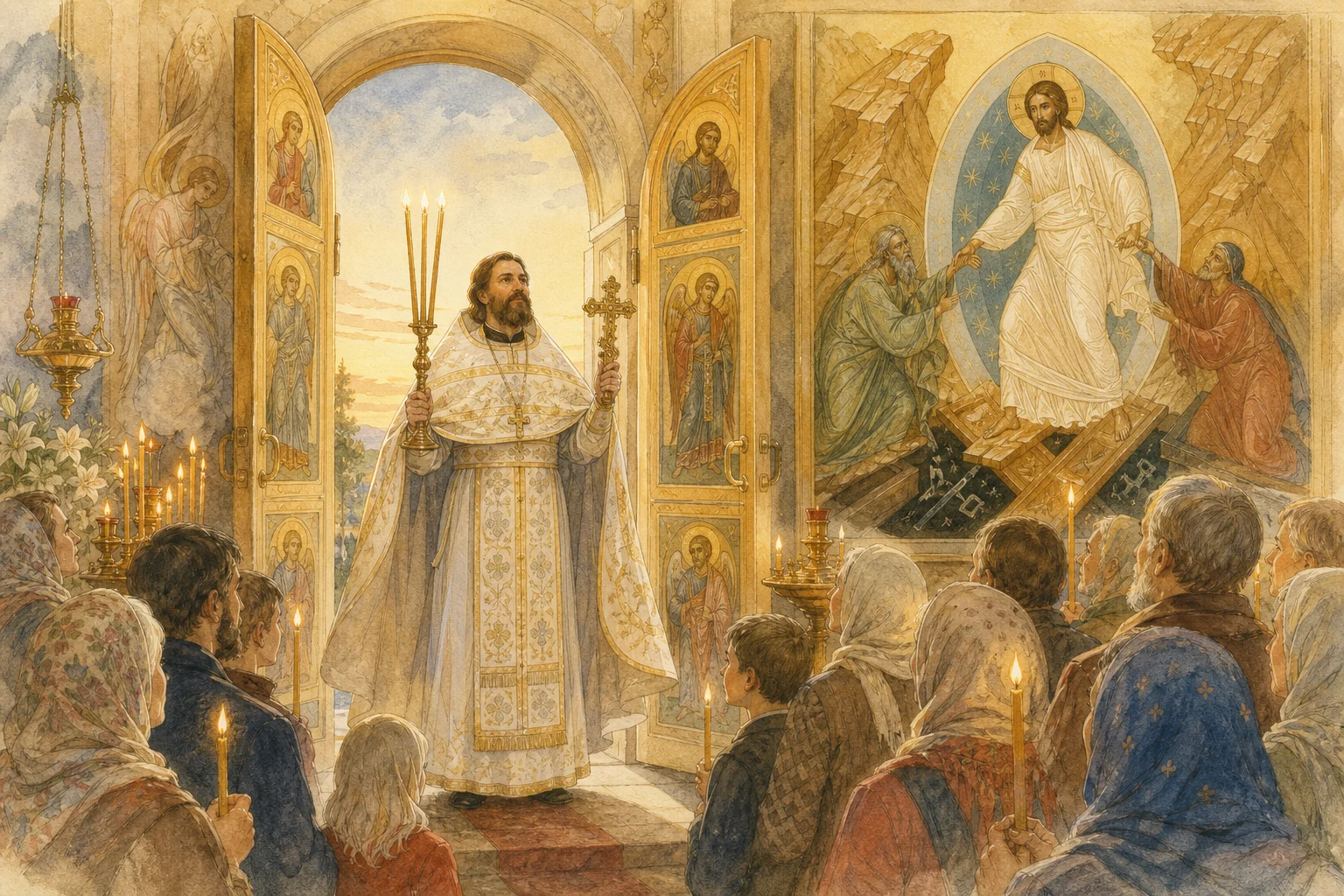
The community leaves the illuminated church for the darkness as though the myrrh-bearing women were approaching the tomb. The return to opened doors expresses passage from expectation to the proclamation that Christ is risen.
The procession is not a race around a building. Protect children, make room for older people, and preserve prayerful attention rather than struggling for the nearest position.
Paschal Matins and the joyful canon
The Paschal greeting is repeated, the canon by Saint John of Damascus is sung, and the church fills with light. Repetition is not emotional manipulation; the Church learns to receive news greater than ordinary experience.
A visitor who understands little Church Slavonic can listen for repeated words, answer with the community, and participate without embarrassment.
The Divine Liturgy and Holy Communion
The summit of the night is not the end of the procession but the Eucharist. A person wishing to receive prepares according to church order through prayer, repentance, the Eucharistic fast, and Confession when required.
Do not approach merely because “everyone receives at Pascha,” and do not remain away through a false belief that holiness belongs only to the flawless. Discuss your circumstances with the priest beforehand.
When a night service is not possible
The overnight Liturgy can be difficult for young children, older people, pregnant women, the ill, and those who work. This does not make anyone less faithful. Many parishes also celebrate a later morning or daytime Liturgy.
Read the schedule, choose a safe option, and never cancel medicine. A person may greet the feast in prayer at home and attend church at an accessible time.
Participating with children
Explain the sequence in simple words, allow the child to sleep beforehand, and bring water and food for after Communion. Choose a place from which the family can step outside briefly.
Do not demand adult stillness throughout the night. Let the child remember light, song, and the kindness of adults rather than fear of correction.
The Paschal greeting
“Christ is risen!” is a concise confession of faith and a mutual witness. The answer “Indeed He is risen!” is not mere etiquette but agreement with the joyful proclamation of the Church.
The greeting continues through the Paschal season. Do not scold a guest who answers uncertainly; offer the words gently and preserve the meaning of joy.
Red eggs and Paschal foods
An egg became an image of life hidden within a closed shell; red recalls life and victory. Paschal bread and other regional foods belong to the festive meal after the fast.
They may be blessed according to the parish schedule, commonly on Holy Saturday or after the night service. Blessing is thanksgiving, not the magical transformation of food.
Must a large basket be blessed?
No. A small amount of food that the household will actually eat is sufficient. Alcohol, money, keys, and random objects do not gain power by being placed nearby.
Do not waste blessed food or compete over decorations. Sharing part with a lonely person or a family in need is particularly fitting.
What is the artos?
The artos is a special loaf blessed at Pascha and kept in church during Bright Week. It is later divided and distributed to the faithful.
It is received reverently as a holy object and a reminder of Christ, the Bread of Life. The artos neither replaces Communion nor functions as magical medicine.
The Orthodox icon of Pascha
The classical Orthodox Paschal image is Christ’s Descent into Hades. The Savior stands above the shattered gates of death and raises Adam and Eve, showing that the Resurrection concerns all humanity.
An image of the empty tomb can recall the Gospel morning, but the Descent into Hades expresses the theological depth of the feast in Orthodox tradition.
Bright Week
The week after Pascha is lived as the continuation of one great day. The royal doors remain open, worship is filled with Paschal hymns, and the usual Wednesday and Friday fast is omitted.
Joy does not mean uncontrolled consumption. Attend worship, remember someone overlooked in the holiday rush, and give patient attention to the household.
Pascha and visiting a cemetery
Pascha is first the celebration of the Resurrection in church and community. Radonitsa is traditionally appointed for a specifically Paschal commemoration of the departed; local cemetery customs vary.
If family circumstances require a visit, pray quietly and do not condemn relatives. Do not leave food or alcohol “for the dead” or turn remembrance into a pagan rite.
The Holy Fire and other signs
The ceremony of the Holy Fire in Jerusalem is honored by many, but Christian faith in the Resurrection does not depend on an annual spectacle, a television signal, or a rumor about a miracle.
Do not circulate threats that the absence of a sign would automatically announce the end of the world. Pascha rests on the Gospel witness and the life of the Church, not a sensational post.
Living the feast during the day
After worship and needed rest, share a moderate meal, call a lonely relative, seek reconciliation where possible, and help someone in need. Joy deepens when it is given away.
Do not demand instant cheerfulness from an exhausted person. A household with an infant, an ill person, or someone grieving may celebrate quietly and authentically.
Common questions
May I come only for the blessing of food?
You may, but blessing food does not replace Paschal worship. If health permits, choose the night or daytime Liturgy and learn the feast’s meaning.
Is a special washing or immersion required?
No. Pascha requires no such rite. Baptism and the Church’s prayer are not replaced by folk actions.
May Christians work on Pascha?
Necessary work, medicine, care, and service are not sins. Find an accessible time for prayer and do not condemn those serving others.
When does the fast end?
After participation in the Paschal Liturgy and the conclusion of the fast. Break the fast moderately, especially after a long restriction.
How should I greet a person of another faith?
With respect and without pressure. The Paschal greeting is a Christian confession, while love of one’s neighbor does not depend on the ability to answer it.
The essential point
Pascha proclaims that Christ is risen, death has been defeated, and the path of life with God is open. This news exceeds festive food, custom, and emotion.
Participate in worship according to your strength, prepare responsibly for Communion, protect the vulnerable, and share joy. The feast can then become not one date but the measure of an entire Christian life.