
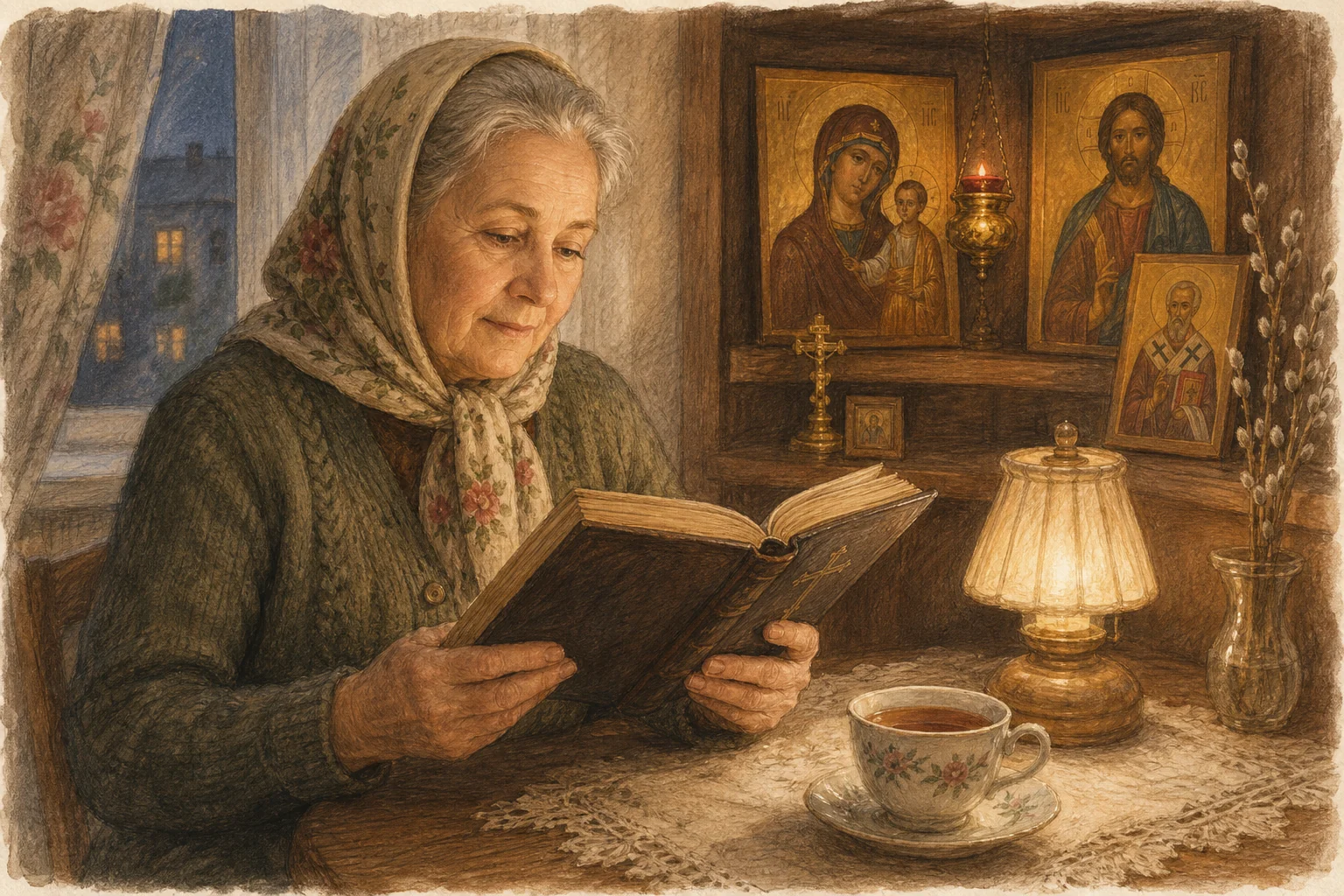
A beginner can read the Psalter at home one psalm a day or one small part of a kathisma. Begin with a brief prayer, read slowly, and notice the address to God, the human condition, and the words of hope. Do not immediately promise to complete the entire Psalter every week.
The Psalms speak in the language of praise, repentance, fear, pain, and thanksgiving. Some lines are unfamiliar and require ecclesial interpretation rather than literal application against a particular person.
What the Psalter is
The Psalter is the biblical book of 150 psalms, associated especially with King and Prophet David, though other authors are also represented. It belongs to the Old Testament and is heard continually in Orthodox worship.
Christ, the apostles, and generations of Christians prayed its words. Reading at home is therefore not a separate esoteric practice; it continues the prayer of the Church.
Why the Psalms fit many human conditions
The book contains solemn praise, confession of sin, the question “how long?”, grief over loss, gratitude for deliverance, and hope amid danger. A person does not need to perform the same emotional state before God every day.
A psalm gives honest feeling a form and directs it toward faith. Yet a single psalm does not always contain the final answer. Its tension may be resolved elsewhere in Scripture and ultimately in Christ.
Which edition should be used?
Choose a Psalter in a language you understand from a recognized Orthodox publisher, or a parallel edition with Church Slavonic and a modern translation. Accent marks and a short glossary help readers who want to learn the liturgical language.
Check that explanatory material comes from a responsible Orthodox source. Not every online list of “special psalms for every problem” reflects the Church’s understanding.
Why psalm numbers sometimes differ
Orthodox liturgical books follow the Greek Septuagint tradition, while many modern Western reference editions follow the Hebrew Masoretic numbering. After the early psalms, the number therefore often differs by one.
Some books print both numbers, with one in parentheses. These are not different Scriptures or an error of faith. When sharing a reference, identify the edition or include the opening words.
What is a kathisma?
For liturgical reading, the Psalter is divided into twenty kathismata. Each kathisma ordinarily has three sections, separated by the doxology “Glory to the Father, and to the Son, and to the Holy Spirit…” and appointed prayers.
A kathisma is a useful large unit, but a beginner is not required to finish one at each sitting. You may stop after one psalm or section and continue later.
How to begin at home
Choose a regular ten-minute period, open the book, and make the sign of the Cross. Read the usual short prayer before Scripture or ask in your own words for understanding and mercy.
Read without haste and select one line to carry into the day. Our guide to reading the Gospel at home offers a similar method using context and a short note.
Are special prayers required before and after a kathisma?
A complete Psalter often prints prayers before beginning and after groups of kathismata. When adopting a sustained, extensive rule, ask a priest how these should be used.
A newcomer reading one psalm may begin and end with a brief prayer. Do not avoid Scripture itself because you have not yet learned every appendix in the volume.
May the Psalter be read sitting?
The word “kathisma” itself is connected with sitting. At home, psalms may be read seated, especially during a longer reading, illness, or fatigue. Many people stand for opening and closing prayers.
Bodily attention is valuable, but health matters more than copying another person’s measure. Posture and bows should be adapted sensibly; our article explains waist bows and prostrations.
How to understand words about enemies
The Psalms arose within real history containing war, betrayal, and danger. A Christian must not use severe lines as a curse against an acquaintance or an excuse for revenge. Christ commands prayer for enemies and refusal to return evil for evil.
Ecclesial interpretation also sees the spiritual struggle with sin, falsehood, and demonic evil. Name pain truthfully, but ask for protection, justice, repentance, and the conversion of people rather than delighting in an imagined punishment.
What to do with unfamiliar images
Mountains, Zion, sacrifices, nations, and kingship carry historical and theological contexts. Do not invent a secret personal meaning for each word. Examine cross-references, a glossary, and an Orthodox commentary.
Write down one question and bring it to a conversation. Understanding the Psalter grows over years; inability to explain every line immediately does not make the reading fruitless.
The Psalter within morning or evening prayer
One short psalm may complement an ordinary rule, but it need not enlarge the rule every day. Psalm 50 is often associated with repentance and psalms of praise with thanksgiving, yet texts should be chosen for meaning rather than as magical specialties.
Our guide to a prayer rule for beginners helps keep the total amount realistic.
Remembering the living and the departed
During home reading, the living and departed may be remembered by name using prayers printed in a recognized Orthodox edition. A particular tradition exists for reading the Psalter for someone who has died and should be approached with sensitivity to the family’s circumstances.
Do not promise an amount you cannot keep or charge for prayer as though selling a guaranteed result. Questions about commemoration can be discussed through the parish contact page.
May I listen to a recording?
An audio recording assists a person with impaired sight, fatigue, or time in transit. Choose clear ecclesial reading and listen where attention is possible. Sound that remains entirely in the background does not replace personal participation.
Following the printed words while listening can help with Church Slavonic pronunciation. When driving, safety remains primary.
What if the reading produces despair or fear?
Pause, reread the immediate context, and choose a psalm of hope or a Gospel passage. Do not receive every accusation as a personal verdict or attempt to diagnose your future from the text.
When fear becomes persistent, discuss it with a priest. Depression, panic symptoms, and impairment of daily life also require appropriate professional support.
The Psalter is not a catalog of guaranteed effects
Lists that assign one psalm to money, another to romance, and another to instant protection can train a magical relationship with Scripture. A psalm may be especially fitting to a need, but God is not controlled by choosing the correct number.
Read within the whole faith of the Church, ask for salvation and wisdom, and let prayer change your action. Practical help, repentance, and the sacraments must not be replaced by repetition alone.
A simple plan for one month
During the first week, read one psalm each day in sequence. In the second, add a brief note containing thanksgiving, a question, and a petition. Later, try one section of a kathisma on a suitable day.
Do not double the amount after a missed day. At the end of the month, determine which pace preserves attention and continue. The goal is familiarity with the Church’s language of prayer, not a record.
How it connects with worship
Psalms and their verses are heard at Vespers, Matins, the Hours, and other services. Familiarity at home makes the liturgical text recognizable and reveals the unity of the daily cycle.
Attend a service listed on the schedule page and listen for a line you know. This is a living way to learn without an examination.
Frequently asked questions
Do I need a blessing to read the Psalter?
No special permission is required for ordinary, modest reading of Scripture. A large permanent rule is best agreed upon with a priest.
May I read only in a modern language?
Yes, begin in a language you understand. A parallel edition can gradually introduce the Church Slavonic text used in Russian worship.
Which psalm should come first?
For consecutive reading, begin with the first. To include one in a prayer rule, choose a familiar short psalm with guidance from a prayer book or priest.
May I read at night?
Yes, provided it does not damage necessary sleep or rest on a superstition that the hour has special automatic power.
What if I use the wrong number?
Compare the opening words and the numbering system of the edition. Such a reference mistake causes no spiritual harm.
The central point
Begin with one psalm, read consecutively and in context, do not aim difficult words against people, and do not turn the book into divination. The language of the Psalter will gradually become part of personal and common prayer.
Take a trusted edition, choose ten minutes, and read the first psalm today. One attentive step is better than a promise of an impossible quantity.