
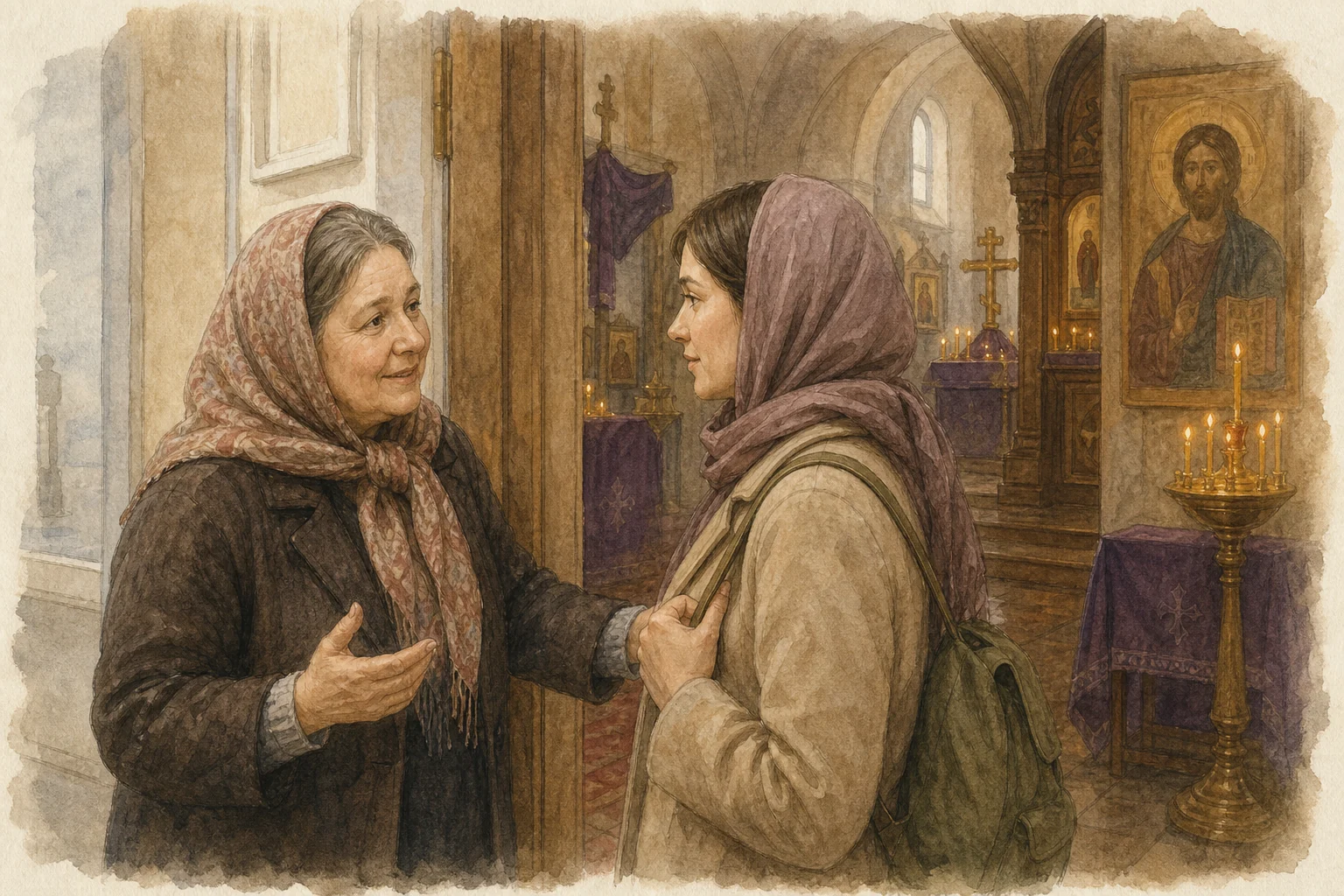
A beginner should enter Great Lent gradually: choose a sustainable food rule, keep a short daily prayer, participate more often in worship, seek reconciliation, and undertake one concrete work of mercy. The first Lent is not a time to copy monastic severity or attempt to repair every part of life in seven weeks.
Great Lent leads toward Pascha through repentance and encounter with Christ. It is not a spring detox, a test of willpower, or a season in which God eagerly punishes an accidental ingredient.
How long is Great Lent?
In ordinary speech, Great Lent often means the path from Clean Monday to Pascha: the forty days of the Fast, Lazarus Saturday, Palm Sunday, and Holy Week. Together this is about seven weeks, or forty-eight days.
The beginning changes each year because the date of Pascha changes. Consult the current Orthodox calendar and the parish service schedule, not a memorandum from a previous year.
Begin with a purpose
Formulate a request rather than only a list of prohibitions: “I want to pray more attentively,” “I want to stop humiliating someone close to me,” or “I want to return to Confession.” One honest aim holds a path better than ten dramatic projects.
Write a concrete next step and a way to review it after a week. “Become spiritual” is vague; “do not answer an insult immediately and return to the conversation after a pause” can be practiced.
Forgiveness before the beginning
On Forgiveness Sunday, the Church calls Christians toward reconciliation. Asking forgiveness does not mean sending an identical message to every contact or demanding an immediate answer. It is better to name real responsibility to the person actually harmed.
Reconciliation does not require return to an unsafe relationship or abandonment of protective boundaries. Where abuse exists, safety comes first. Forgiveness does not erase an offender’s accountability.
Choosing a food rule
The general direction is abstinence from meat, dairy, and eggs, while rules concerning fish, oil, and wine vary by day. A layperson must consider health, age, work, and experience rather than mechanically transferring a monastic rule.
If you have never fasted, begin with a sustainable measure and discuss it with a priest. The broader purpose is explained in Orthodox Fasting: Its True Purpose.
Do not turn fasting into starvation
Food must remain sufficient. Plan protein, regular meals, and accessible ingredients such as legumes, grains, vegetables, bread, nuts, and fish on permitted days. Constant hunger often ends in overeating and anger.
Do not replace familiar food with endless expensive imitations. Simplicity should free attention and resources rather than create a new culinary project.
A prayer rule for the first year
Keep morning and evening prayers in a realistic measure. Add the Prayer of Saint Ephrem when appointed and a short Gospel passage. Ten attentive minutes every day are better than two hours once.
If you are still learning, use our prayer rule for beginners. Do not increase the amount after every feeling of guilt.
Services especially associated with Lent
During the first week the Great Canon of Saint Andrew of Crete is read. The Liturgy of the Presanctified Gifts is served on appointed weekdays; Sunday worship continues, and the final portion leads through Lazarus Saturday and Holy Week.
A beginner does not have to attend everything. Choose the Sunday Liturgy and one additional service each week. Arrive a little early and ask calmly where a translation or service text may be found.
Why Lenten worship feels unfamiliar
Lenten services are quieter and longer, with prostrations and distinctive hymns. At first, do not attempt to understand every detail. Listen for repeated petitions and notice the movement from repentance toward hope.
You may sit because of weakness and step out briefly without disturbing others. Reverence is not measured by pain in the legs.
Confession before the final crowded days
Do not postpone a first Confession in many years until Holy Saturday. Contact the parish near the beginning of Lent, learn the practice, and request an unhurried appointment if the history is long.
Speak concretely about your own actions. Our guide to Confession after a long absence provides a safe structure.
Holy Communion and preparation
Great Lent does not mean waiting until Pascha for a single Communion. Discuss frequency and preparation with a priest in light of actual church life and health.
Do not change prescribed medication or hide medical restrictions. The Eucharistic fast and the longer discipline of Great Lent are connected but distinct questions.
Place mercy on the calendar
Choose a repeatable work: a weekly call to a lonely person, help for a family, a volunteer shift, or a modest regular donation. One emotional gesture may help, but a practice reshapes life more deeply.
Serve without publishing another person’s hardship. Ask about current community needs through the parish contact page.
Fasting of speech and social media
Choose one point of practice: do not post while angry, disable evening notifications, or remove a habitual app from the first screen. Give the recovered attention to a living person and prayer.
Do not simply replace one feed with a religious feed. Endless arguments about fasting severity are also a form of distraction.
Work, study, and family
A heavy schedule does not exclude fasting but affects its measure. Prepare simple food beforehand, keep a brief prayer while traveling, and do not force the whole household to eat according to your rule.
If a spouse does not fast, do not turn the table into a mission field. Prepare neutral shared dishes and respect the other person’s freedom.
Illness and medication
Diabetes, pregnancy, nursing, eating disorders, medical treatment, and old age require medical judgment. Do not cancel protein, medicine, or a procedure because of an online fasting table.
Ask for a dispensation and move effort toward prayer, moderation, speech, and mercy. Our article on fasting during illness and treatment addresses this in detail.
When you fail
Do not declare the fast ruined. One episode does not cancel the path. Stop, do not consume every restricted food out of defiance, and continue with the next decision.
Examine the cause: insufficient food, an excessive rule, a social situation, or stress eating. Correcting the cause is more useful than punishment.
The beginning, middle, and final part
At the beginning, establish a rhythm without increasing it daily. In the middle, when novelty disappears, protect the minimum and return after missed days. During Holy Week, attend to the services and Gospel events rather than trying to compensate for everything with food severity.
Pascha is not a prize for perfect statistics. It is the feast of Christ’s Resurrection toward which the Church leads both the strong and the tired.
A practical weekly minimum
Sunday Liturgy; one additional Lenten service; morning and evening prayer; an agreed food rule; one evening without feeds; one act of reconciliation; and one work of help. This is enough for an honest beginning.
After seven days, keep what works and adjust what is impossible. Fasting is a school of faithfulness, not a one-time test.
Common questions
May I begin after the first day?
Yes. Do not wait for another year. Begin today with a sustainable measure and prayer, without pretending that the previous days did not happen.
Must I attend church every day?
Monastic and parish rhythms differ. Choose a stable pattern in light of work, family, and health.
May I celebrate a birthday?
A peaceful gathering with an appropriate meal is possible. Consider the calendar, avoid drunkenness, and do not impose your rule on guests.
What if my family objects?
Do not preach through irritation. Begin with personal moderation, cook without display, and discuss practical arrangements peacefully.
Must the final week be maximally strict?
Holy Week is especially important liturgically, but a sudden medically dangerous regimen is not a virtue. Keep the measure already agreed.
The essential point
Great Lent for a beginner is not an attempt to become a monk for forty-eight days. It is a realistic union of food discipline, prayer, Confession, worship, reconciliation, and mercy.
Begin with something small and concrete. If the measure damages health or family peace, do not abandon Lent; seek advice and correct the way you are living it.